
Understanding SWOT Analysis: A Strategic Tool for Effective Corporate Planning
E N D
Presentation Transcript
S.W.O.T. ANALYSIS
History of SWOT • Background stemmed from the need to find out why corporate planning failed • Research was funded by fortune 500 companies to find out what could be done about the failure • Research team headed by Stanford Research Institute 1960-1970 • Result-corporate planning in the shape of long range planning was not working, did not pay off, and was an expensive investment in futility
What was the problem • Missing link was how to get the management team to agree and commit to a comprehensive set of action programs • 1100 organizations were interviewed and a 250-item questionnaire was designed and completed by over 5,000 executives • Seven key findings lead to the conclusion
7 Key Findings • Values • Appraise • Motivation • Search • Select • Program • Act • Monitor and repeat step 1,2 and 3
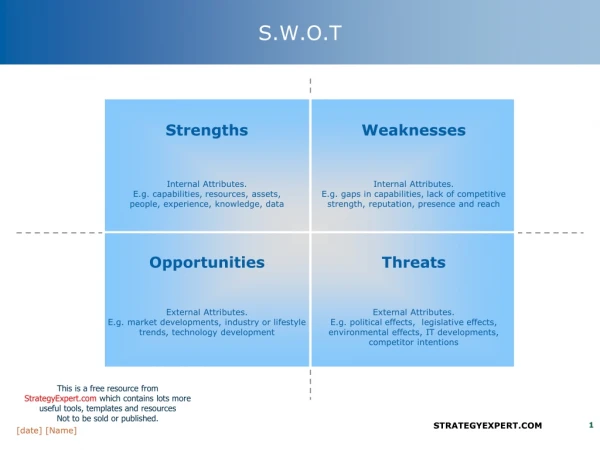
Could not change Values so….. • Started with the first step by asking…. • What is good and bad about the operation? • What is good and bad about the present? • What is good in the present is Satisfactory • What is bad in the present is a Fault • What is good and bad about the future? • What is good in the future is Opportunity • What is bad in the future is a Threat SOFT became SWOT
What is it? • A SWOT analysis measures a business unit, a proposition or idea • Subjective assessment of data which is organized by the SWOT format • Logical order which helps understanding, presentation, discussion and decision-making
Its strategic planning • Strategic planning is just management speaking for long term future planning • Strategic planning concerns anything that will bring results in anything from 1 to 5 years. • Good management practices to raise your head above the daily grind and take action to positively affect your future
What can it assess? • A company (its position in the market, commercial viability,etc.) • A method of sales distribution • A product or brand • A business idea • A strategic option, such as entering a new market or launching a new product • A opportunity to make an acquisition • A potential partnership • Changing a supplier • Outsourcing a service, activity or resource • An investment opportunity
SWOT • Strengths (maintain, build and leverage) • Weakness (priorities and optimize) • Opportunities (remedy or exit) • Threats (counter)
Identifying actions • It all depends on your reason and aims for using SWOT • Your ability to manage others • Can concentrate on a department rather than a whole business • Can reflect the functional parts of a department
Step 1 • In the here and now….. • List all strengths that exist now • Then in turn, list all weaknesses that exist now • Be realistic but avoid modesty
Step 2 • What might be….. • List all opportunities that exist in the future • Opportunities are potential future strengths • Then in turn, list all threats that exist in the future • Threats are potential future weaknesses
Step 3 • Plan of action…. • Review your SWOT matrix with a view to creating an action plan to address each of the four areas
Example (small internet business who employ mostly contractors)
Example- Action Plan • Strengths- maintain low overheads by changing pay structure to balance basic pay with performance based bonuses • Weakness-implement project planning system and follow it • Opportunities- test new market with one existing product • Threats-include contractors in performance based bonus scheme
Action Plan • Based on the SWOT Analysis, the association is better positioned to take appropriate and effective action ( What is wrong with this action plan?)
Strength Questions • What do we do exceptionally well? • What advantages do we have? • What valuable assets and resources do we have/ • What do members/customers identify as our strengths?
Tips • Be realistic….and honest • Think in terms of what you have that your competitors don’t have • Don’t just take the internal staff and volunteer perspective…consider how your members and customers view your organization
Weakness Questions • What could we do better? • What are we criticized for or receive complaints about? • Where are we vulnerable?
Tips • Don’t tiptoe around weaknesses, but be constructive and positive in putting them on the table • Get research so you know what outsiders think….about you and your competition
Opportunity Questions • What opportunities do we know about, but have no been able to address? • Are there emerging trends on which we can capitalize?
Tips • Look at changes in the sector represented by the organization, technological changes, government policy, socioeconomic and demographic changes • Be open-minded…key opportunities may come from unlikely and seemingly unrelated sources • Consider how you can exploit your strengths or address your weaknesses to generate additional opportunities
Threat Questions • Are any of our weaknesses likely to make us critically vulnerable? • What external roadblocks exist that clock our progress? • Are our competitors or quasi-competitors doing anything different? • Is there significant changes coming in our members’ sector? • Is technology dramatically changing the sector and services to it? • Are economic conditions affecting our financial viability
Tips • Have an open and expansive perspective • The buggy whip manufacturing association may not have seen early automobiles as a big threat to the association…but they were! • An environmental scan is critical
Final Thoughts • The process is important not only for identifying where to apply resources and attention, it enables the organization to put issues into perspective • If the organization has a major competitor, it can also be illuminating to conduct a SWOT analysis of the competitor • The process can assist in identifying strategies to counter the competition • To anticipate the competitions future moves