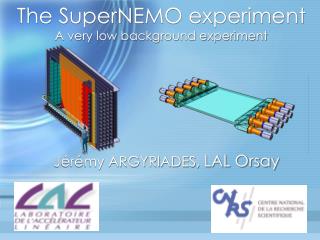
The SuperNemo BiPo detector
160 likes | 287 Vues
The BiPo detector, developed by Jean-Stephane Ricol and team, aims to measure the contamination levels of 208Tl and 214Bi in source foils used for the SuperNemo experiment, with a target sensitivity of less than 2 µBq/kg for 208Tl and 10 µBq/kg for 214Bi. This initiative supports the search for neutrinoless double beta decay with an anticipated sensitivity below 50 meV for neutrino effective mass. Utilizing advanced scintillator technology, the BiPo detector promises to enhance the precision of background measurements essential for future experiments in neutrino physics.


The SuperNemo BiPo detector
E N D
Presentation Transcript
The SuperNemo BiPo detector Jean-stephane Ricol CENBG - CNRS VIeme rencontres du Vietnam Hanoi August 2006
Motivation Current bb0n experiment sensitivity on neutrino effective mass ~ 0.2-1 eV SuperNemoaimed sensitivity < ~ 50 meV T1/2 (82Se 150Nd) > ~ 1026 yrs - BG < 1 evt/100kg/yr High level of purification for the source foils Goal of the BiPo detector : Measure the contamination in 208Tl and 214Bi of the bb source foilsbefore the installation in SuperNEMO 5 kg of source (12 m2, 40 mg/cm2) in 1 month with a sensitivity of 208Tl < 2 µBq/kg and 214Bi < 10 µBq/kg
Bi-Po Process 238U 214Po e- Scintillators + PMT T0, Qb(214Bi)=3.2 MeV (164 ms) b 214Bi (19.9 mn) a 210Pb 22.3 y 0.021% Tracking (wire chamber) a (delay 164µs) 210Tl (1.3 mn) Source foil (40 mg/cm2) 232Th 212Po (300 ns) b 212Bi (60.5 mn) a 208Pb (stable) 36% e- 208Tl (3.1 mn) BiPo detection Use the Bi-Po coincidence in the decay chain
Bi-Po Process 238U 214Po e- Scintillators + PMT T0, Qb(214Bi)=3.2 MeV (164 ms) b 214Bi (19.9 mn) a 210Pb 22.3 y 0.021% Tracking (wire chamber) a (delay 300 ns) 210Tl (1.3 mn) Source foil (40 mg/cm2) 232Th 212Po (300 ns) b 212Bi (60.5 mn) a 208Pb (stable) 36% e- 208Tl (3.1 mn) BiPo detection Use the Bi-Po coincidence in the decay chains a delay T1/2 ~ 300 ns Drift time ~ µsec / cm 212Po a cant be detected in the wire chamber need a dedicated detector
Bi-Po Process 238U 214Po e- Scintillators + PMT T0, Qb(212Bi)=2.2 MeV (164 ms) b 214Bi (19.9 mn) a 210Pb 22.3 y 0.021% Tracking (wire chamber) 210Tl (1.3 mn) Source foil (40 mg/cm2) 232Th 212Po (300 ns) b a Scintillator + PMT 212Bi (60.5 mn) a 208Pb (stable) 36% e- 208Tl (3.1 mn) BiPo detection Use the Bi-Po coincidence in the decay chains a adelay T1/2 ~ 300 ns Edeposited ~ 1 MeV
e- e ~ 0.5 e- goes up a e ~ 0.5 a goes down e ~ 0.25a escapes from the foil with a energy > 1 MeV (~150 keV for energy deposited in the scintillator due to the quenching) Efficiency Thickness of the foil (mg/cm2) Initial energy of the a: E = 8.750 MeV Efficiency Total efficiency ~ 6%
Scintillator plate Thickness=1cm (as MOON-1 prototype) Foil to be measured Gamma tagging 0.8m g e- a g Two possible designs studied in R&D • Multilayer scintillator plates without tracking • Alpha scintillator with electron tracking detector • e- tagging • Efficiency x 4 • Compact geometry & less channels Measurement of 214Bi is not possible (214Po T1/2 = 164 µs high random coincidence bkg) Radon emanation detector developed by Heidelberg
Technique can be very usefull for a and e- identification with the multi-layers design e- a Parallel R&D : Ultra thin scintillator Ultra-thin scintillating detector (plastic or fiber) for a measurement and e- tagging (e- cross the a calorimeter) • Advantages: • e ~ 25% Can be used in both designs e- a Foil to be measured
Parallel R&D : Ultra thin scintillator Thickness of UTS : All a detected if. > 90 µm Optimal for e- ~200-500 µm Crossing efficiency ~ 65-50% DE ~ 100-200 keV • Material possibilities : • Plastic : Kharkov produce 2m long x few cm large x 200 µm • Fibers : Bicron produces scint. fiber 250 µm (square or round section) To be tested : Light yield ? Radiopurity ?
Ultra Low Background Detector 5 kg of 82Se source foil (~ 12 m2, 40 mg/cm2) 50 (e-, delay a) 212Bi decays / month 2 mBq/kg of 208Tl 3-12 decays / month e ~ 6-25 % Background < 1 event/month is required ! Ultra high radiopurity required for the surface of the scintillator
Prompt e-, T0 Prompt e-, T0 e- e- a a delay a, T1/2 ~ 300 ns Prompt e-, T0 Main origin of background Surface contamination of 208Tl on the entrance surface of the lower scintillator Bulk contamination Surface contamination Bkg event NOT rejected Bkg event rejected e- <deposited energy> ~ 50 keV in 100 µm of scintillator
40 ns < Tdelay < 130 ns a e- T0 electron (trigger) Dt between a and e- (in ns) electron energy (MeV) a energy (MeV) Fit between 40 and 130 ns : T 1/2 = (212 +/- 65) ns ~ 300 ns expected Qb ~ 2.2 MeV quenching Analysis of such BG in NEMO-3 data 1642 events observed in 1 year of data Factor 10 Too High !!! If all comes from mylar wrapping : 2.5 mBq/kg
Capsule BiPo-1 PM 5” e =1 cm Prototype BiPo-1 • Goal of this prototype: Background measurement • Random coincidence from single counting rate of the scint. + PMT • scintillator blocs: 20 x 20 x 1 cm • Surface contamination 212Bi on scintillator entrance surface Surface treatment : Very thin layer e = 200 nm of ultrapure aluminium deposit on the scintillator surface NEMO-3 equipments: radiopure 5” PMTs, radiopure scintillators First capsule installed in Canfranc laboratory end of september 2006
Up to 25 capsules can be installed in Phase I 1050 2000 300 1450 x 1450 2300 x 2300 Prototype BiPo-1 Shield Test Facility: external: 2.3 m x 2.3 m x 2 m internal: 1.45 m x 1.45 m x 1.05 m Radon-tight tank (pure iron) Free radon air Lead shield (13 tons) Water shield
70 cm Prototype BiPo-1 Phase II Bg measurement of multi layers design
Conclusion • BiPo detector must reach a sensitivity of few µBq/Kg • Different designs are under study, they will be tested during 2007-2008 with first prototypes • The final BiPo detector is planned to be built and installed in the Canfranc laboratory in 2009