Regular Languages and Finite Automata
70 likes | 184 Vues
This guide explores the concepts of Deterministic Finite Automata (DFA) and Nondeterministic Finite Automata (NFA), focusing on how to devise these automata for specific languages. It discusses the closure properties of regular languages, including the proof of irregularity through the Pumping Lemma. Additionally, it examines statements about nonregular languages and the implications of concatenating regular and nonregular languages. Topics include prime number patterns in languages, as well as the balance of zeroes and ones in binary words.


Regular Languages and Finite Automata
E N D
Presentation Transcript
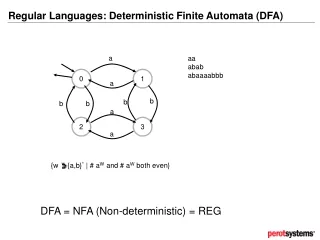
Devising DFAs/NFAs • Devise DFAs/NFAs for the following languages:
True or False? • If L is a nonregular language and M is a regular language then their • concatenation LM is not regular. • All finite languages L are regular.
Proof of Irregularity - Using Pumping Lemma {ai | i is a prime number} { 0i1j | i > j } The set of words that contain twice as many 0’s as 1’s.