Understanding Water in the Atmosphere: The Water Cycle and Cloud Formation
210 likes | 330 Vues
This educational resource explores the essential role of the sun as the primary energy source for Earth's surface phenomena, including winds, ocean currents, and the water cycle. Students will learn about key concepts such as humidity, evaporation, condensation, and dew point. The lesson involves outdoor cloud identification, a discussion about cloud formation, and an in-depth look at different cloud types: cirrus, cumulus, and stratus. By using instruments like the psychrometer, students will engage with practical applications of these concepts.


Understanding Water in the Atmosphere: The Water Cycle and Cloud Formation
E N D
Presentation Transcript
Water in the Atmosphere Chapter 6 Section 1
Standard • S 6.4 a Students know the sun is the major source of energy for phenomena on Earth’s surface; it powers winds, ocean currents and the water cycle.
Anticipatory Set • Go Outside and try to identify the clouds you see outside. • Take the map we created last week to help you. • Have a discussion as to which stratosphere the clouds you see are located
Language of the Discipline • Water Cycle • Evaporation • Humidity • Relative humidity • Psychomotor • Condensation • Dew point • Cirrus • Cumulus • Stratus
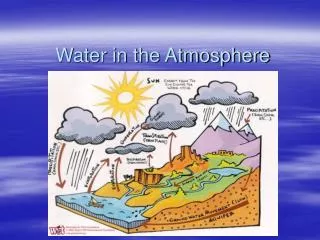
Water in the Atmosphere • Water cycle is the continuous movement of water between the atmosphere and Earth’s surface • Sun’s energy is the power to the water cycle • Has no real beginning or end • Water vapor is added to the air by living things • Plant roots, leaves and releases it as water vapor
Humidity • The measure of the amount of water vapor in the air • Relative Humidity • The percent of water vapor that is actually in the air compared to the amount of water vapor the air can hold at a specific temperature • Relative humidity can be measured with an instrument called a psychomotor. • Psychrometer wet bulb/dry bulb thermometer
How Clouds Form • Clouds form when water vapor in the air condense to form liquid water or ice crystals. • Role of Cooling • Cold air holds less water vapor • As air cools, it holds less and forms tiny drops of water • Dew point- temperature at which condensation begins • If dew point is below freezing then it changes into ice crystals.
Particles • For water vapor to condense, tiny particles must be present so the water has a surface on which to condense • Blades of grass • Window panes • Dew • Can you thing of anything else that has dew on it?
Types of Clouds • Cirrus- Wispy, feathery clouds (like the curl of a hair) • Made of ice crystals • Looks like rows of cotton balls • Indicates a storm is on it’s way • Looks like scales of fish
Cumulus Clouds • Fluffy, round piles of cotton • Heap or mass of clouds • Not very tall • Indicate • Common on sunny days
Stratus Clouds • Spread out clouds • Covers all or most of the sky • Uniform dull, gray in color • As they thicken, they produce rain, drizzle or snow
Clouds • Part of a clouds name is based on it’s height • Altocumulus • Altostratus • “Middle level” clouds • Alto- “high”
Fog • Clouds that form at or near the ground • When the ground cools at night after a warm day • Heat from the next day “burns” the fog off and it evaporates • Common near bodies of water or marshy areas
Checking for Understanding • What instrument measures relative humidity? • What 2 factors are required for condensation to occur? • What are stratus clouds?
Guided PracticeIndependent Practice • Worksheet # 1-5 for Guided Practice • Stop! Have work checked • Independent Practice • Workbook pages