AR_VR_App_Development_Services (11)
AR/VR app development services involve designing and building immersive, interactive software that blends digital content with the real world (augmented reality) or creates entirely virtual environments (virtual reality). These services cover custom app creation for mobile and headsets to enhance user engagement, training, and 3D visualisation across industries like retail, gaming, healthcare, and real estate.

AR_VR_App_Development_Services (11)
E N D
Presentation Transcript
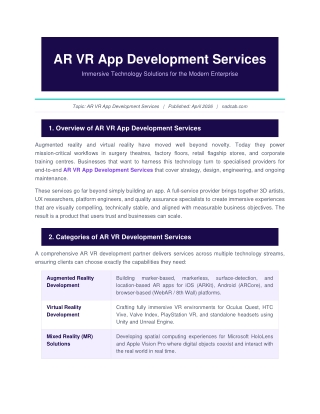
AR VR App Development Services Immersive Technology Solutions for the Modern Enterprise Topic: AR VR App Development Services | Published: April 2026 | nadcab.com 1. Overview of AR VR App Development Services Augmented reality and virtual reality have moved well beyond novelty. Today they power mission-critical workflows in surgery theatres, factory floors, retail flagship stores, and corporate training centres. Businesses that want to harness this technology turn to specialised providers for end-to-end AR VR App Development Services that cover strategy, design, engineering, and ongoing maintenance. These services go far beyond simply building an app. A full-service provider brings together 3D artists, UX researchers, platform engineers, and quality assurance specialists to create immersive experiences that are visually compelling, technically stable, and aligned with measurable business objectives. The result is a product that users trust and businesses can scale. 2. Categories of AR VR Development Services A comprehensive AR VR development partner delivers services across multiple technology streams, ensuring clients can choose exactly the capabilities they need: Building location-based AR apps for iOS (ARKit), Android (ARCore), and browser-based (WebAR / 8th Wall) platforms. marker-based, markerless, surface-detection, and Augmented Reality Development Crafting fully immersive VR environments for Oculus Quest, HTC Vive, Valve Index, PlayStation VR, and standalone headsets using Unity and Unreal Engine. Virtual Reality Development Developing spatial computing experiences for Microsoft HoloLens and Apple Vision Pro where digital objects coexist and interact with the real world in real time. Mixed Reality (MR) Solutions
Capturing and post-processing stereoscopic 360 video for VR headset playback, virtual tours, live events, and interactive documentary formats. 360-Degree Video Production Custom enterprise platforms for remote collaboration, digital twin visualisation, field service decision-support dashboards. AR/VR for Enterprise assistance, and executive Scenario-based training simulations for healthcare, aviation, defence, manufacturing, and emergency response where safe, repeatable practice is essential. XR Training & Simulation Real-time networked VR environments for virtual conferences, co-working spaces, branded metaverse activations, and multiplayer entertainment products. Social & Multiplayer XR Virtual try-on, in-space product placement, 3D configurators, and AR-powered packaging that shortens the path from discovery to purchase. AR Commerce & Retail 3. Technology Stack Powering These Services World-class AR VR development relies on a carefully selected set of tools and frameworks chosen for performance, cross-platform reach, and long-term support: Industry-standard real-time engine for cross-platform AR and VR apps, with a vast ecosystem of plugins, shaders, and community resources. Unity 3D Photorealistic rendering powerhouse ideal for high-fidelity VR experiences, architectural visualisation, and cinematic simulations. Unreal Engine Apple's and Google's native AR frameworks providing world tracking, plane detection, light estimation, and face anchoring on mobile. ARKit / ARCore Browser-native XR standards enabling zero-install AR and VR experiences accessible via any modern smartphone or headset browser. WebXR / 8th Wall Open, royalty-free standard from Khronos Group that enables a single codebase to target Oculus, SteamVR, HoloLens, and future headsets. OpenXR
Professional 3D modelling, rigging, and animation tools used to create optimised assets that meet real-time performance budgets. Blender / Maya Networking frameworks that handle real-time synchronisation for multiplayer VR sessions with low latency and reliable state management. Photon / Mirror Cloud infrastructure for spatial anchors, content delivery, user analytics, AI-driven recognition, and scalable backend services. AWS Spatial 4. Industry-Specific Applications AR VR development services deliver tangible value across a broad range of sectors. The table below highlights key use cases by industry: Surgical simulation, anatomy education, phobia treatment, remote diagnostics. Healthcare Virtual classrooms, interactive science labs, language immersion environments. Education Virtual property walkthroughs, AR interior staging, off-plan visualisation. Real Estate AR product try-on, 3D storefronts, in-aisle navigation, loyalty activations. Retail VR design studios, AR assembly guidance, virtual showrooms, remote diagnostics. Automotive AR-assisted maintenance, digital twins, safety training, quality inspection. Manufacturing Virtual destination previews, AR heritage trails, immersive hotel tours. Tourism Virtual concerts, immersive brand activations, hybrid event experiences. Media & Events Tactical simulation, equipment familiarisation, mission rehearsal. Defence Hazard training, remote site inspections, pipeline maintenance guidance. Oil & Gas
5. Service Delivery Models Clients have different needs, budgets, and timelines. A professional AR VR development firm offers flexible engagement structures to fit each scenario: Engagement Model Best Suited For Key Characteristics Fixed-Price Project Startups, MVPs, well-defined scopes Agreed deliverables, timeline, and cost upfront with milestone-based payments. Dedicated Team Scale-ups, long-term product roadmaps Embedded AR/VR specialists who work exclusively on your product full-time. Staff Augmentation Enterprises with internal dev teams Specialist engineers fill skill gaps without replacing existing infrastructure. Consulting & Audit Businesses evaluating XR feasibility Strategy workshops, technical assessments, and roadmap definition services. Managed Services Post-launch maintenance needs Ongoing SLA-backed support covering updates, patches, and performance monitoring. 6. The AR VR Service Delivery Lifecycle Delivering reliable immersive applications requires a structured process that balances speed with quality at every stage: Stakeholder interviews, user research, hardware selection, KPI definition, and technical feasibility analysis to align the project with business goals. Discovery & Strategy Spatial UI wireframes, 3D storyboards, motion comfort guidelines, and accessibility standards tailored to immersive environments. UX & Interaction Design High-fidelity 3D modelling, texturing, rigging, and animation optimised for target device polygon budgets and frame rate requirements. Asset Production
Engine setup, scene construction, physics integration, AR/VR SDK binding, backend API connection, and multiplayer networking where applicable. Core Development Frame rate profiling, thermal testing, motion-sickness comfort validation, device compatibility matrix testing, and load testing for backend services. Performance Testing Store submission preparation for App Store, Google Play, and Meta Quest Store, including compliance documentation and age-rating classification. Certification & Launch Bug triage, OS and SDK update patches, analytics-driven UX improvements, and feature roadmap development based on real-world usage data. Post-Launch Support 7. Key Benefits of Professional AR VR Development Services Investing in professional AR VR services yields advantages that compound over time across customer experience, operational efficiency, and brand value: Accelerated product visualisation that lets buyers configure and experience products before they are manufactured or shipped, compressing sales cycles. • Measurable reductions in training time and incident rates when hazardous procedures are rehearsed repeatedly in risk-free virtual environments. • Higher conversion rates in e-commerce when shoppers can visualise products in their own space through AR before committing to a purchase. • Stronger memory retention in educational and corporate training contexts, as immersive environments engage multiple senses simultaneously. • Reduced travel and logistics expenditure for global teams that use shared VR workspaces for design reviews, collaboration, and decision-making. • Brand differentiation through experiences that competitors cannot replicate quickly, establishing market leadership in technology adoption. • Rich behavioural analytics captured during in-experience interactions that reveal user preferences and attention patterns unavailable through any other channel. • Scalable content delivery as cloud-based AR and VR assets update instantly across all devices without requiring new app store submissions. • 8. Evaluating an AR VR Development Service Provider
Not all development firms have the depth of expertise required to deliver polished, production-grade immersive applications. Evaluate potential partners against these criteria before signing an engagement: Review shipped titles across multiple industries and device categories to assess both visual quality and technical complexity. Portfolio Quality Verify active experience shipping on your target platforms: mobile AR, standalone VR, PC VR, MR headsets, or WebAR. Platform Breadth Prefer firms with dedicated 3D artists, UX designers, AR/VR engineers, and QA specialists rather than outsourced or freelance networks. In-House Team Demand sprint-based milestones with working demos, transparent progress reports, and documented decision logs throughout the engagement. Agile Delivery Ask specifically about frame rate targets, comfort guidelines, and how performance budgets are enforced during asset production. Performance Standards Confirm clear IP assignment clauses, NDA practices, GDPR compliance, and data handling policies especially for enterprise and healthcare projects. IP & Data Security Ensure contractual post-launch support covering critical bug fixes, headset OS updates, and SDK deprecation within defined response windows. Support SLAs Request direct references from clients in similar industries and engage in structured conversations about delivery quality and communication. Client References 9. Future Trends Shaping AR VR Development Services The field of immersive development continues to evolve rapidly. Service providers that stay ahead of the following trends will deliver the most durable value to their clients: Spatial computing platforms such as Apple Vision Pro are redefining the boundary between AR and VR, demanding entirely new interaction paradigms built around eye tracking, hand gestures, and ambient awareness. • Generative AI is being embedded directly into XR workflows, enabling dynamic environment generation, AI-driven NPC behaviour, and personalised training scenarios that adapt in real time to •
learner performance. Cloud-rendered VR removes the need for expensive local hardware by streaming photorealistic scenes from GPU clusters to lightweight headsets over 5G and high-bandwidth Wi-Fi connections. • WebXR maturation is eliminating app installation barriers, making browser-based AR and VR experiences the default format for marketing, retail, and media campaigns. • Haptic feedback wearables and full-body tracking suits are increasing physical immersion in training, rehabilitation, and entertainment applications beyond what hand controllers can deliver. • Digital twins powered by real-time IoT data feeds are converging with VR visualisation tools to create live operational dashboards for factories, smart buildings, and infrastructure management. • Persistent shared AR layers anchored to real-world GPS coordinates are enabling city-scale collaborative experiences for tourism, retail, and civic engagement. • 10. Why Nadcab Technology for AR VR App Development Services Nadcab Technology has built a reputation as a dependable partner for immersive application development, serving clients across healthcare, retail, education, manufacturing, and enterprise sectors. The company's multidisciplinary team delivers the full spectrum of AR VR development services with a commitment to quality, transparency, and measurable outcomes. Dedicated 3D artists, UX designers, Unity and Unreal Engine engineers, and QA specialists working under one roof for consistent quality control. Full In-House Team Proven delivery on iOS, Android, Meta Quest, HTC Vive, HoloLens, PlayStation VR, and WebAR from a single integrated development team. Multi-Platform Delivery Sprint-based delivery with weekly demos, real-time project dashboards, and structured milestone reviews that keep clients fully informed. Agile & Transparent Fixed-price, dedicated team, and staff augmentation models to match the budget and risk profile of startups and enterprise clients alike. Flexible Pricing SLA-backed support packages covering bug fixes, SDK updates, feature additions, and performance optimisation for the full product lifecycle. Post-Launch Commitment
End-to-end IP protection, GDPR-aligned data practices, and confidentiality agreements that protect sensitive client assets and user data. Security & Compliance Professional AR VR App Development Services give businesses the creative and engineering capabilities needed to build immersive applications that engage customers, train employees, and streamline complex operations. From mobile AR overlays and standalone VR simulations to enterprise mixed reality platforms, these services span the full technology stack and the complete product lifecycle. Selecting a partner with proven multi-platform experience, an in-house team, and a structured delivery process is the single most important step toward realising the full commercial potential of augmented and virtual reality. Summary Explore expert AR VR App Development Services at https://www.nadcab.com/ar-vr-app-development