Larval Morphological Characteristics of Labridae and Related Families in Celebes Sea
110 likes | 232 Vues
This study explores the larval morphological traits of Labridae (wrasses) and adjacent families in the Celebes Sea, highlighting the challenges in species-level identification due to the high number of species (35 genera, approx. 300 species in the Indo-Pacific). It discusses various types within Labridae, including Halichoeres, Thalassoma, Cirrhilabrus, Cheilinus, and Xyrichthys, examining their myomeres, gut structures, body shapes, and pigmentation patterns through larval stages. The research utilizes Bongo gear, with samples collected in August 2007.


Larval Morphological Characteristics of Labridae and Related Families in Celebes Sea
E N D
Presentation Transcript
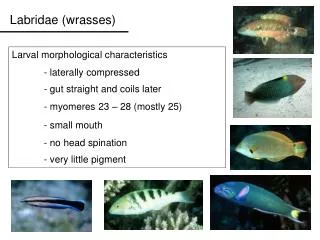
Labridae (wrasses) Larval morphological characteristics - laterally compressed - gut straight and coils later - myomeres 23 – 28 (mostly 25) - small mouth - no head spination - very little pigment
Labridae (wrasses) Species level identification is difficult – WHY? • high species number (35 genera, 300 species Indo-Pacific) • meristic characters overlap • Celebes Sea Labrid Types • General Body Shape • Pigment Patterns Location: Celebes Sea Date: August 2007 Gear: Bongo (521 um)
Labridae Type A probably Halichoeres sp. • eyes slightly narrow, choroid tissue • long, pointed snout • gut coiled in postflexion • no pigment throughout larval stage 6.0 mm Myomeres: 23 D: IX, 13 A: III, 13 P1: 12 C: 12 8.6 mm
Labridae Type B probably another Thalassoma sp.(Fahay) • general body shape similar with Type A • dorsal spines form early • pigments on anterior dorsal fin membrane 3.9 mm • head larger than other labrids Myomeres: 25 D: VIII, 12 A: III, 11 P1: 14 C: 12 6.0 mm
Labridae Type C Probably Cirrhilabrus sp. 6.0 mm • heavy pigment on dorsal portion of gut • pigment enlarges as larvae mature 3.9 mm 7.4 mm Myomeres: 25 D: XI, 9 A: III, 9 P1: 14 C: 13
Labridae Type D Probably Cheilinus sp. 6.0 mm • body deep • no pigmentation • early forming pectoral fin 4.6 mm 3.9 mm 7.4 mm Myomeres: 25 D: IX, 10 A: III, 9 P1: 14 C: 13 6.2 mm
Labridae Type E Probably Xyrichthys sp. 6.0 mm 9.2 mm • body elongated, very laterally compressed • head small and pointed 11.2 mm Myomeres: 25 D: IX, 12 A: III, 11 P1: 12 C: 14 • mouth very small • eye elliptical, choroid tissue • first two dorsal spines originate in nape • gut initially straight, coils after flexion
6.6 mm 7.0 mm Scaridae (parrot fishes) • body laterally compressed, ovoid in cross section • head small, mouth small, snout round 3.9 mm • gut straight initially, coiled at flexion • gut rugose at posterior end • eye elliptical, choroid tissue • pigment series along base of anal fin to caudal, dorsal gut Myomeres: 25 D: IX, 10 A: III, 9 P1: 14 C: 14 11.2 mm
6.6 mm 7.0 mm Scaridae (parrot fishes) 3.9 mm • Gobiidae same myomere count • but, no rugose gut, very conspicuous bladder, eyes round • Myctophidae with rugose gut • but, myomeres >30, no series of pigment 11.2 mm
Coryphaenidae (dolphinfishes) Coryphaena hippurus • body elongated, head moderately blunt • heavy pigmentation 3.9 mm 3.8 mm 11.2 mm Myomeres: 63 D: 23 A: 23 P1: 13 C: 14 6.2 mm
Coryphaenidae (dolphinfishes) Coryphaena hippurus Coryphaena equiselis - no barred pigmentation - no pigment on pelvic fin (older larvae) 3.9 mm 3.8 mm Rachycentridae - gut more heavily pigmented than body - head slightly elongated 11.2 mm 6.2 mm