Exploring the Electromagnetic Spectrum: Understanding Light and Color
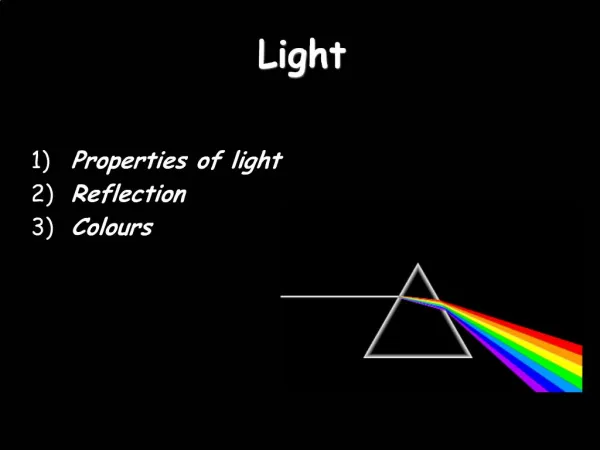
White light consists of various colors that can be revealed when passed through a prism, demonstrating the concept of the visible spectrum. The wavelength, or the distance between wave crests, influences the color we perceive. Light can also be described in terms of photons, which are particles that exhibit energy levels based on their wavelength. Additionally, the process of absorption and emission occurs when electrons in atoms absorb light energy and transition to higher energy levels, later emitting that energy as light or heat at specific wavelengths.

Exploring the Electromagnetic Spectrum: Understanding Light and Color
E N D
Presentation Transcript
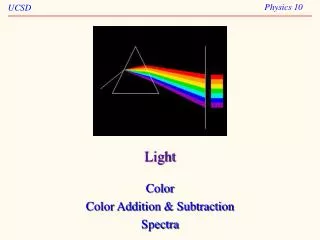
Spectrum • White light is composed of many colors • Passing light thru a prism reveals the colors of the spectrum
Wavelength • Distance between crests of the wave. • Different colors are due to different wavelengths of light.
figure 08-04.jpg Figure 8.4 Figure 8.4
Electromagnetic Spectrum • Radio waves 100 M • Microwaves 10-3 M or mm • Infrared 10-6 M or um • Visible light 10-10 M or Angstrum • 4000-7000 • Ultraviolet 100-4000 Angstrums • X-ray 1-100 Angstrums
figure 08-05.jpg Figure 8.5 Figure 8.5
Photons • Light is also emitted as a particles. • Photons have specific amounts of energy. • Depends on the wavelength as well.
Absorption/Emission • Electrons of atoms absorb light energy • They move to higher energy levels • When they return the energy is emitted • Energy is usually emitted as heat or light and at specific wavelengths
figure 08-06.jpg Figure 8.6 Figure 8.6