Engaging Introductions: Techniques to Captivate Your Readers
Mastering the art of writing effective introductions is key to captivating your audience. A well-crafted introduction sets the tone for your piece and engages readers from the very beginning. In this guide, explore various techniques to open your writing: ask a thought-provoking question, make a bold statement, share a personal experience, use a quote, or present a riddle. These approaches not only grab attention but also establish the direction of your narrative, ensuring your readers are eager to dive deeper into your work.

Engaging Introductions: Techniques to Captivate Your Readers
E N D
Presentation Transcript
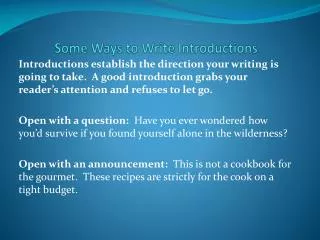
Some Ways to Write Introductions Introductions establish the direction your writing is going to take. A good introduction grabs your reader’s attention and refuses to let go. Open with a question: Have you ever wondered how you’d survive if you found yourself alone in the wilderness? Open with an announcement: This is not a cookbook for the gourmet. These recipes are strictly for the cook on a tight budget.
Open with a bold and challenging statement: Contrary to what some people think, most of our learning takes place out of school. Open with a quotation from somebody: “You’re going to regret this.” That’s what my best friend Liza said as I got on the roller coaster. Open with a riddle or a puzzle that the reader can grapple with: What textbook has no pages, is miles wide, smells like a creek and has been around for millions of years? That’s right – Outdoor School.
Open with a personal experience: I’m still glad I didn’t cry at the funeral, though I did in my room later. Open with how you felt: My hands were sweaty! My teeth wouldn’t quit chattering. Prickly fingers ran up my spine. What would happen next?