Understanding Motivation: Beyond Simple Definitions and Characteristics
Motivation is often misunderstood as a tangible quality possessed by organisms. It is not just an inherent trait, but rather a complex field of study focused on the various factors that influence behavior. These factors include reinforcement, punishment, discrimination, and elicitation of responses. To comprehend motivation, we must examine the motivational operations and conditions such as deprivation, stimulation, social context, and physiological states, which are akin to initial conditions in physics that dictate behavior and responses.

Understanding Motivation: Beyond Simple Definitions and Characteristics
E N D
Presentation Transcript
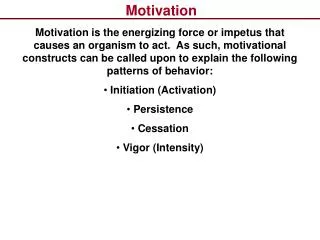
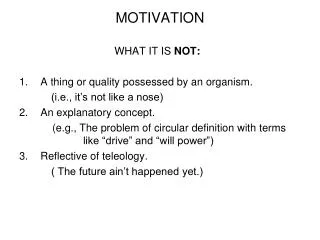
MOTIVATION WHAT IT IS NOT: A thing or quality possessed by an organism. (i.e., it’s not like a nose) 2. An explanatory concept. (e.g., The problem of circular definition with terms like “drive” and “will power”) Reflective of teleology. ( The future ain’t happened yet.)
WHAT IS IT THEN? Refers to a field of study devoted to the specification and analysis of those variables that control the (1) reinforcing, (2) punishing, (3) discriminative, and (4) eliciting properties of events.
ESTABLISHING or MOTIVATIONAL OPERATIONS/CONDITIONS • These conditions are comparable to initial and boundary conditions in physics and include: • (1) deprivation • (2) stimulation • (3) temporal variations • (4) social context • (5) experiential history • (6) physiological states