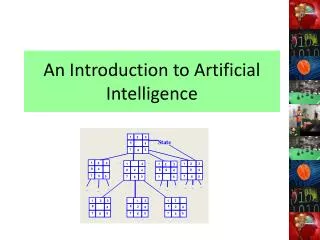
An Introduction to Artificial Intelligence
This introduction to Artificial Intelligence (AI) delves into key concepts including the Turing Test, Chinese Room test, and essential AI processes like search algorithms, knowledge representation, and natural language processing. It covers diverse AI areas such as game playing, expert systems, theorem proving, and neural networks. The guide also discusses evolutionary algorithms and the significance of agent-based technologies, while highlighting AI programming languages like Prolog and Lisp, their paradigms, and modern implementations. Discover how AI models human cognition and enhances problem-solving capabilities.

An Introduction to Artificial Intelligence
E N D
Presentation Transcript
Introduction • Getting machines to “think” . • Imitation game and the Turing test. • Chinese room test. • Key processes of AI: • Search, e.g. breadth first search, depth first search, heuristic searches. • Knowledge representation, e.g. predicate logic, rule-based systems, semantic networks.
Areas of AI • Game playing • Theorem proving • Expert systems • Natural language processing • Modeling human performance • Planning and Robotics • Neural-networks • Evolutionary algorithms and other biologically inspired methods • Agent-based technology
Game Playing • Getting the computer to play certain board games that require “intelligence”, e.g. chess, checkers, 15-puzzle. • A state space of the game is developed and a search applied to the space to look ahead. • Example: Deep blue vs. Kasparov. .
Theory Proving • Automatic theorem proving. • Generate proofs for simple theorems. • Mathematical logic forms the basis of these systems. • The “General Problem Solver” is one of the first systems. .
Expert Systems • Performs the task of a human expert, e.g. a doctor, a psychologist. • Knowledge from an expert is stored in a knowledge base. • Examples: ELIZA, MYCIN, EMYCIN • Suitable for specialized fields with a clearly defined domain. .
Natural Language Processing • Develop systems that are able to “understand” a natural language such as English. • Voice input systems, e.g. Dragon. • Systems that “converse” in a particular language. • Examples: SHRDLU and ELIZA .
Modeling Human Performance • Systems that model some aspect of problem solving. • Examples: Intelligent tutoring systems that provide individualized instruction in a specific domain. .
Planning and Robotics • Involves designing flexible and responsive robots. • Lists of actions to be performed are generated. • Aimed at high-level tasks, e.g. moving a box across the room. • Has led to agent-oriented problem solving.
Neural Networks • Aimed of low-level processing. • Are essentially mathematical models of the human brain. • A neuron: .
Evolutionary Algorithms & Other Nature-Inspired Algorithms • Based on Darwin’s theory of evolution. • An initial population of randomly created individuals is iteratively refined until a solution is found. • Examples: genetic algorithms, genetic programming, memetic algorithms • Other methodologies: ant colonization, swarm intelligence. .
Uncertainty Reasoning • Uncertain terms may need to be presented. • Example: representing terms such as “big” or “small”. • Methods for this purpose: • Fuzzy logic • Bayesian reasoning and networks .
Agent-based Technology • Intelligent agents, also called “softbots”, are used to perform mundane tasks or solve problems. • In a multi-agent system agents communicate using an agent communication language. .
Artificial Intelligence Languages • Programming paradigms • Artificial intelligence languages – Prolog and Lisp • Prolog (Programming Logic) – declarative – predicate logic • Lisp (List Processing) – functional – code takes the form of recursive functions. • More recently AI systems have been developed in a number of languages including Smalltalk, C, C++ and Java.