Understanding Federalism: Powers and Responsibilities in Texas Government
This lesson explores the principle of federalism as outlined in the Texas Constitution. Students will identify the distribution of powers between state and federal governments, highlighting responsibilities such as creating money, setting up schools, and enforcing laws. Through activities like a Venn diagram and a cinquain poem, learners will analyze how these powers are shared and why federalism is crucial to the United States' government structure. Engage in discussions about the implications of power sharing and the importance of separation of powers.

Understanding Federalism: Powers and Responsibilities in Texas Government
E N D
Presentation Transcript
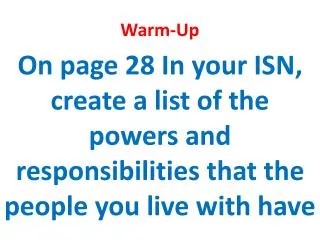
Warm-Up On page 28 In your ISN, create a list of the powers and responsibilities that the people you live with have
Learning Target I can identify how the Texas Constitution reflects the principle of federalism.
Hypothesis Test Power is equally divided between the state and federal governments.
Federalism • The principle of federalism works a lot like a family • Federalism is the division of power and responsibility between the national and state governments • Federalism says there are things only the states can do, some things only the federal government can do, and some things they both can do
Draw the following in your ISN Federal State Both
Who should have the Power? To coin and create money
Who Has the Power? Federal Government
Who should have the Power? Set-up schools and school districts
Who Has the Power? State Government
Who should have the Power? Collect taxes
Who Has the Power? BOTH
Who should have the Power? Enforce Laws
Who Has the Power? BOTH
Who should have the Power? Create local governments
Who Has the Power? State Government
Who should have the Power? Declare War
Who Has the Power? Federal Government
Who should have the Power? Make Laws
Who Has the Power? BOTH
Who should have the Power? Build Roads
Who Has the Power? BOTH
Who should have the Power? Conduct elections
Who Has the Power? State Government
Who should have the Power? Create treaties between countries
Who Has the Power? Federal Government
Strongly Agree, Agree, Disagree, Strongly Disagree Power is equally divided between the state and federal governments.
Follow-Up Questions • Looking at your venn-diagram, what inferences can you make about Federalism? • Why should power be shared between the Federal and State government in the United States? • Would you rather have a government that didn’t believe in separation of powers or a government that didn’t believe in Federalism?
Federalism Cinquain • Line 1: Name of the principle • Line 2: 2 adj. to describe the principle • Line 3: 3 –ing words to explain the principle • Line 4: 4-word summary of the principle • Line 5: 1-word synonym for the principle