Understanding the Electromagnetic Spectrum: Light, Waves, and Color
The electromagnetic spectrum encompasses all types of electromagnetic radiation, including visible light, which is merely a fraction of the energy around us. Waves in the spectrum are characterized by their wavelengths, measured in nanometers. Our eyes can only detect wavelengths between 390 and 750 nm. The relationship between wavelength and frequency determines the color we perceive; shorter wavelengths correspond to higher frequencies. This guide explores these concepts, the scattering of light, and why the sky appears blue while sunsets are red.

Understanding the Electromagnetic Spectrum: Light, Waves, and Color
E N D
Presentation Transcript
Open your textbooks to Page 380 “Light and Colour”
Let’s read page 382 and 383 “Energy in a Wave”
Write the definitions for the bolded terms on page 382 and 383 into your notebook You have 8 minutes...GO
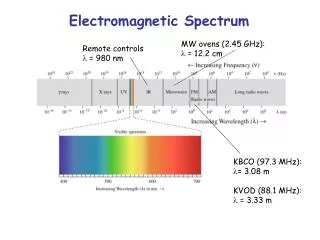
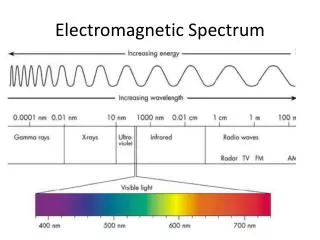
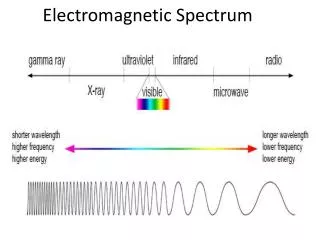
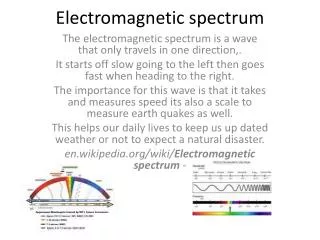
Electromagnetic Spectrum • Visible light is only a tiny fraction of the energy that surrounds us every day • We are surrounded by invisible light-like waves, which together with visible light are called “electromagnetic radiation” • Electromagnetic radiation is a wave pattern made of electric and magnetic fields that can travel through empty space • The entire range of electromagnetic radiation is called the Electromagnetic Spectrum
Electromagnetic Spectrum Writing Activity • With a partner, write a SHORT definition for each type of wave and ray found in the electromagnetic spectrum • Draw a diagram of the spectrum in your notes
Colour Wavelengths & The Visible Spectrum • Light travels in waves • Each colour of the rainbow has its own wavelength • Wavelengths are measured in nanometres. • One nanometre is equal to one billionth of a meter. • Our eyes can only detect wavelengths approximately between 390 – 750 nm • Red has the longest wavelength, while violet has the shortest wavelength
Relationship Between Frequency (Hz) and Wavelength of Colours • Frequency is the rate of repetition in a cycle • 1 Hz is equal to 1 wave cycle per second The longer the wavelength, the less the frequency The shorter the wavelength, the higher the frequency
Blue Sky vs. Red Sunset • Air will scatter short-wavelength light in preference to long-wavelength light. • Long-wavelength light will pass through the air • The blue color we see is blue light waves scattered down toward us from the white sunlight passing through the air overhead • At night, the sun is tangent to the Earth. The light’s path is longer, so the short-wavelength light gets scattered out, leaving the colour red which has a longer wavelength.