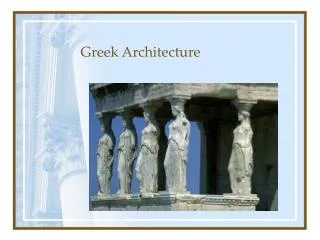
Greek Architecture
Greek Architecture. Western Civilization University High School 2011-12. The Earliest Greek Architecture. first inhabitants of Greek peninsula (Neolithic people?) built primitive, basic structures usually circular, oval, or rectangular made with mud bricks and stones, with reeds or brush

Greek Architecture
E N D
Presentation Transcript
Greek Architecture Western Civilization University High School 2011-12
The Earliest Greek Architecture • first inhabitants of Greek peninsula (Neolithic people?) built primitive, basic structures • usually circular, oval, or rectangular • made with mud bricks and stones, with reeds or brush • typically one room
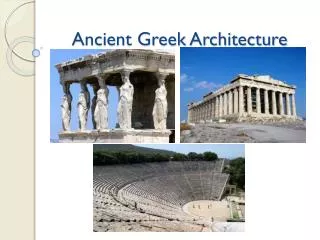
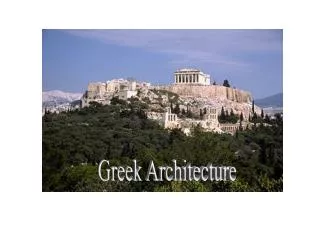
The Emergence of Temples • as city-states developed, temples were built for 2 primary purposes: • 1. religious worship of a god(s)/goddess(es) • A home for god who controls part of nature… • 2. military fortress • Why is the acropolis typically on top of a hill…? • Greek columns = most striking feature
Entablature • Cornice • Frieze • Column • Capital • Base
Parts of a Column • Frieze: part of the entablature that is often decorated with plaster images
Types of Columns Doric Ionic Corinthian
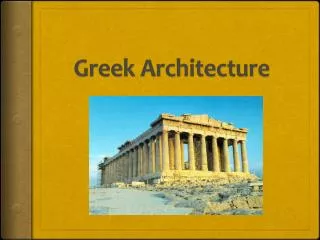
The Parthenon in Athens • construction begins in 447 BCE, ends in 432 BCE • replaced an older temple for Athena destroyed in Persian invasion in 480 BCE • notable for its Doric columns
Doric Pillars • Doric order = simplest (and earliest) ancient Greek architecture • invented around 600 BCE • most associated with Sparta • used in mainland Greece, and then many Greek colonies later • masculine look • simple, block-like capitals
Ionic Pillars • taller, more slender than Doric columns • capital looks like a rolled up scroll • invented around 500 BCE • became dominant in Hellenistic period • feminine look
Corinthian Pillars • invented around 450 BCE • capital has flowers and leaves • not used as often because it was so ornate • more extensive use in Roman architecture
Greek Architecture Project • 12 paper clips • 8 rubber bands • 24 inches of scotch tape • 2 markers or pens • 12 thumb tacks • 16 pieces of 8.5 x 11” white paper • A base for your temple (cardboard, wood, etc.)