Understanding Common Denominators for Adding Fractions
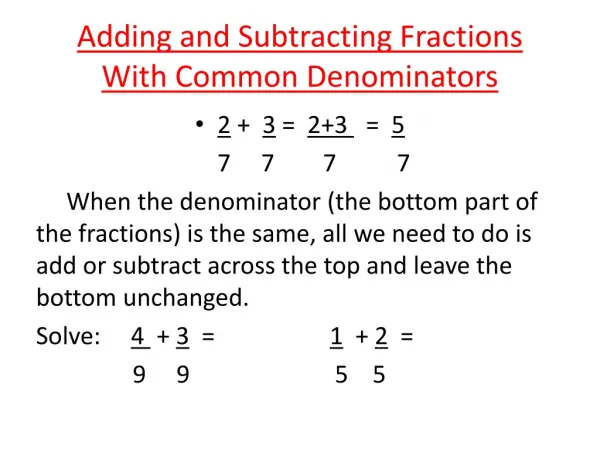
This guide explains how to add fractions with common denominators. Fractions represent “pieces” of a whole, such as a pie divided into three equal pieces. When the denominators (the bottom numbers) of the fractions are the same, you can easily add them by summing the numerators (the top numbers). For example, if you have 1/3 and 2/3, the common denominator is 3. Simply add the numerators: 1 + 2 = 3, resulting in 3/3, which simplifies to 1 whole.

Understanding Common Denominators for Adding Fractions
E N D
Presentation Transcript
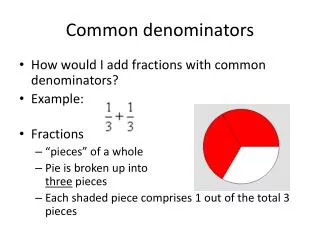
Common denominators • How would I add fractions with common denominators? • Example: • Fractions • “pieces” of a whole • Pie is broken up into three pieces • Each shaded piece comprises 1 out of the total 3 pieces
Common denominators • When the denominators (numbers on the bottom of the fractions) are the same, simply add the numerators (numbers on the top of the fractions) Numerator Denominator
Common denominators • When the denominators (numbers on the bottom of the fractions) are the same, simply add the numerators (numbers on the top of the fractions)