Understanding the CELDT: Support for English Learners in the Classroom
This resource outlines essential information about the California English Language Development Test (CELDT), focusing on identifying English learners, utilizing CELDT data effectively, and enhancing instructional strategies. With a comprehensive approach, we address the Home Language Survey, new English Language Development standards aligned with Common Core, and insights into the ELAC. Learn about the various domains of CELDT including Listening, Speaking, Reading, and Writing, and discover ways to support students in their journey to fluency.

Understanding the CELDT: Support for English Learners in the Classroom
E N D
Presentation Transcript
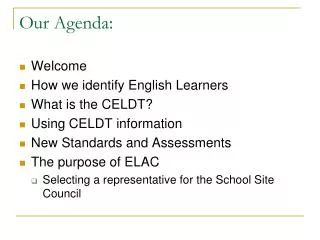
Our Agenda: • Welcome • How we identify English Learners • What is the CELDT? • Using CELDT information • New Standards and Assessments • The purpose of ELAC • Selecting a representative for the School Site Council
Identification: • Home Language Survey: • First Language Student Learned? • Language Student Speaks at Home? • Languages Spoken by Student? • Language Spoken by Adults in Home? • Initial and Annual Assessment: • CELDT • CA English Language Development Test
EL, IFEP, RFEP • English Learner • How can we help? • Classroom (Teacher) • Extra classes (Reading Teacher and Instructional Aides) • Fluent English Proficient • IFEP = Initially (right away) • RFEP = Redesignated(later on)
What’s coming in the Future… • New English Language Development Standards aligned to Common Core Standards for English Language Arts • New Assessments • CELDT • SBAC
English Learner Advisory Committee • Meets 2-3 times per year • Comments, Suggestions, Concerns… • ELAC Representative on School Site Council (Meets monthly)
CELDT - Listening Domain • Four Components • Following Oral Directions • Teacher Talk • Extended Listening Comprehension • Rhyming (Grades K/1 and 2 only)
Speech Functions • Asking for information • Making a request • Offering an item/assistance • Giving a warning
CELDT Reading Domain • K/1 Reading • Word Analysis-orally and individually • identify letters and recognize sound-letter relationships • Fluency and Vocabulary-orally and individually • identify pictures associated with the words and sentences • read simple words out loud • Reading Comprehension-orally and individually • identify parts of a book
Reading Domain • Grades 2 - 12 Reading • Word Analysis-groups • read and respond to multiple-choice questions about word formation rules • Fluency and Vocabulary- groups. • read and respond to multiple-choice questions about grade-appropriate vocabulary • Reading Comprehension- groups • read passages and respond to multiple-choice comprehension questions
CELDTWriting Domain:Writing Sentences Write a sentence that describes what is happening in each picture.