Download
1 / 54
540 likes | 691 Vues
This guide provides an overview of Earth's atmosphere, including its structure, composition, and the essential processes that govern weather and climate. It examines the four main layers of the atmosphere—troposphere, stratosphere, mesosphere, and thermosphere—along with key concepts such as air pressure, thermal energy, and the greenhouse effect. Readers will learn about the gases present in the atmosphere, the role of the ozone layer, and how temperature variations influence weather patterns. This resource is a crucial study aid for understanding atmospheric science.

E N D
Ch. 13 The Atmosphere Mrs. Samsa
The condition of Earth’s atmosphere at a particular time and place • Temperature • Thermal energy • Climate • Weather
Earth’s atmosphere consists of all of the following except: • Nitrogen • Carbon dioxide • Potassium • Oxygen • Water Vapor • Argon
Air has all of the following except • Gravity • Mass • Density • Pressure
The amount of ______ in the air varies greatly from place to place. • Carbon dioxide • Nitrogen • Water vapor • Oxygen
The force of the weight of a column of air pushing on an area is called • Convection currents • Air pressure • Gravity • Newtons
The air that surrounds us and that we breathe has the greatest percentage of . . . • Oxygen • Nitrogen • Ozone • Carbon dioxide • Water vapor • Methane
An instrument that is used to measure air pressure • Thermometer • Anemometer • Barometer • Psychrometer
As altitude increases . . . • Air pressure increases • Molecules get closer together • Density increases • Air pressure decreases
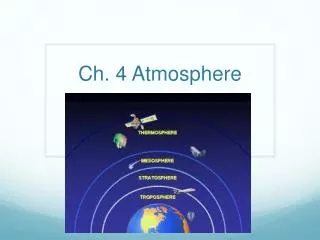
Scientists divide Earth’s atmosphere into four main layers according to • Changes in temperature • Changes in color • Changes in amount of water vapor • Changes in gravity
Which of the following is in the correct order? • Thermosphere, mesosphere, stratosphere, troposphere, ionosphere, exosphere. • Troposphere, stratosphere, mesosphere, thermosphere, ionosphere, exosphere. • Stratosphere, mesosphere, troposphere, ionosphere, exosphere, thermosphere. • Troposphere, mesosphere, stratosphere, thermosphere, exosphere, ionosphere
In this layer, electrically charged particles create amazing light displays called auroras. • Exosphere • Mesosphere • Thermosphere • Ionosphere • Stratosphere • Troposphere
The ozone layer can be found in the • Troposphere • Mesosphere • Thermosphere • Stratosphere • Ionosphere • Exosphere
In this layer, our weather occurs and most commercial airplanes travel. • Mesosphere • Troposphere • Thermosphere • Ionosphere • Exosphere • Stratosphere
The coldest layer of the atmosphere is • Troposphere • Mesosphere • Thermosphere • Stratosphere • Ionosphere • Exosphere
Meteoroids burn up and look like shooting stars in the . . . • Exosphere • Ionosphere • Thermosphere • Mesosphere • Stratosphere • Troposphere
Which is not something that would happen if our ozone layer disappeared? • People would get skin cancer. • Plants and animals would get sun burned or negatively affected by UV Rays. • Visible light would disappear. • People would get horrible sun burns.
Air moves in large circular patterns because of • Convection currents • Conduction currents • Pressure belts • Trade winds • The greenhouse effect
What causes differences in air pressure around the Earth? • Warm air sinks at the equator and cold air rises at the poles. • Cold air sinks at the equator and warm air rises at the poles • Warm air rises at the equator and cold air sinks at the poles. • Cold air rises at the equator and warm air sinks at the poles.
Temperature can reach up to 1800 degrees C but there is not much heat because the molecules are so far apart in the … • Exosphere • Ionosphere • Mesosphere • Stratosphere • Troposphere • Thermosphere
Where is air pressure the greatest? • Stratosphere • Thermosphere • Ionosphere • Mesosphere • Troposphere • Exosphere
The ozone layer protects us from . . . • Infrared radiation • Electromagnetic waves • Visible light • Ultraviolet light • Heat waves
The layer of the atmosphere that contains most of the mass is the • Exosphere • Mesosphere • Thermosphere • Ionosphere • Troposphere • Stratosphere
The layer where GPS and TV satellites and space shuttles orbit is the . . . • Thermosphere • Stratosphere • Mesosphere • Ionosphere • Exosphere • Troposphere
Energy travels to Earth as . . . • Electromagnetic waves • Convection currents • Ionic waves • Seismic waves
Infrared radiation are ______ waves that have wavelengths that are _______ than visible light • Heat, shorter • Convection, longer • UV, shorter • Heat, longer • Convection, shorter
Ultraviolet light is a(an) _________ form of energy with wavelengths that are ______ than visible light. • Conduction, shorter • Radiation, longer • Invisible, shorter • Heat, longer • Invisible, longer • Convection, longer
The process where dust-size particles and gases in the atmosphere dispense light in all directions is called . . . • Scattering • Diffraction • Refraction • Reflection • Absorption • Convection
The sky looks blue because of ______ which happens to short blue wavelengths more than long red wavelengths. • Reflection • Diffraction • Absorption • Scattering
A natural process which keeps Earth at a comfortable temperature is called . . • Global warming • Global climate change • Greenhouse effect • Hole in ozone layer • Conduction cells
70% of the energy that reaches the troposphere is ____ by land, water and the atmosphere. • Scattered • Reflected • Diffracted • Absorbed • Radiated
Humans may put more gases like carbon dioxide, methane and water vapor in the atmosphere which will increase ___ and could lead to ___ • Global warming, the greenhouse effect • The greenhouse effect, a hole in the ozone layer • Pollution, the Coriolis effect • The greenhouse effect, global warming
Local and global winds are caused by • Unequal heating of Earth’s surface • Unequal amount of greenhouse gases • Unequal temperatures in the layers of the atmosphere • Unequal density in the layers of the atmosphere
The total amount of energy of motion in the particles of a substance is called . . . • Temperature • Climate • Thermal energy • Conduction
The average amount of energy of motion of each particle in a substance is called . . . • Climate • Thermal energy • Weather • Heat • Temperature
The tea in a pot has _____ thermal energy than tea in a cup even though the temperature is the same because it has _______ • More, less mass • More, more mass • Less, less mass • Less, more mass • More, greater density • Less, lesser density
Transfer of heat between two substances that are in direct contact is • Conduction • Convection • Radiation • Thermal waves • Convection currents
The transfer of heat by the movement of a fluid (liquids and gases) is • Electromagnetic waves • Conduction • Convection • Radiation • Coriolis effect
The direct transfer of energy by electromagnetic waves is . . . • Conduction • Convection • Radiation • Thermal energy • Temperature • Climate
____ works well in metals, but air and water do not transfer heat well by this method. • Conduction • Convection • Radiation • Insulation
The fact that your basement is cooler in the summer than your attic is because of . . . • Conduction • Convection • Radiation • Thermal energy • The Coriolis effect
In the troposphere most of the heat transferred is by . . . • Conduction • Convection • Radiation • Ultraviolet radiation • Visible light
The movement of air from areas of high pressure to low pressure is called • Convection currents • Wind • Air pressure • Windchill factor • Coriolis Effect
The instrument used to measure wind speed is … • Windmeter • Windchill factor • Thermometer • Barometer • Wind vane • Anemometer
During the day, the land heats up faster (low pressure), water is cooler (high pressure) so . . . • Wind blows from sea to land (land breeze) • Wind blows from sea to land (sea breeze) • Wind blows from land to sea (land breeze) • Wind blows from land to sea (sea breeze)
During the night, land cools down faster, water is warmer, so … • Wind blows from sea to land (sea breeze) • Wind blows from sea to land (land breeze) • Wind blows from land to sea (sea breeze) • Wind blows from land to sea (land breeze)
Which of the following are not global wind belts? • Doldrum • Horse latitude • Southern currents • Trade winds • Prevailing westerlies • Polar easterlies
A global wind belt with calm winds at 30O north and south is • Doldrums • Horse latitudes • Prevailing westerlies • Polar easterlies • Trade winds • Land breeze
A calm area where warm air rises and there is little to no wind at the equator is . . . • Polar easterlies • Prevailing westerlies • Doldrums • Horse latitudes • Trade winds
In the Northern hemisphere, global winds turn clockwise and in the Southern hemisphere they turn counterclockwise because of … • Polar easterlies • The greenhouse effect • Prevailing westerlies • Doldrums • Horse latitudes • The Coriolis effect