
Holistic Optimization Techniques for Database Applications
E N D
Presentation Transcript
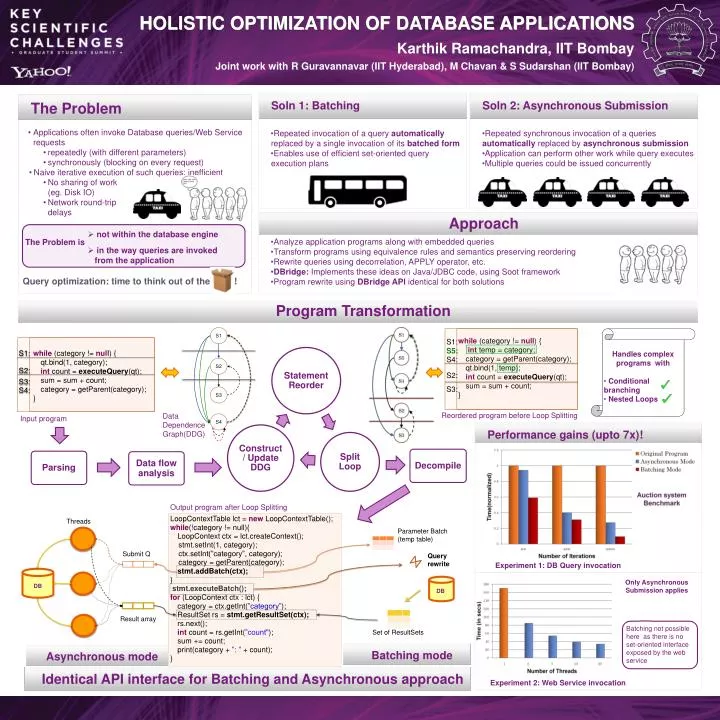
HOLISTIC OPTIMIZATION OF DATABASE APPLICATIONS KarthikRamachandra, IIT Bombay Joint work with R Guravannavar(IIT Hyderabad), M Chavan & S Sudarshan (IIT Bombay) LoopContextTable lct = new LoopContextTable(); while(!category != null){ LoopContext ctx = lct.createContext(); stmt.setInt(1, category); ctx.setInt(”category”, category); category = getParent(category); stmt.addBatch(ctx); } stmt.executeBatch(); for (LoopContext ctx : lct) { category = ctx.getInt(”category”); ResultSet rs = stmt.getResultSet(ctx); rs.next(); int count = rs.getInt(”count"); sum += count; print(category+ ”: ” +count); } S1 S2 S3 while(category!= null){ inttemp = category; category = getParent(category); qt.bind(1, temp); intcount = executeQuery(qt); sum = sum + count; } S1: S5: S4 S4: • Applications often invoke Database queries/Web Service requests • repeatedly (with different parameters) • synchronously (blocking on every request) • Naive iterative execution of such queries: inefficient • No sharing of work (eg. Disk IO) • Network round-trip delays The Problem S2: • Analyze application programs along with embedded queries • Transform programs using equivalence rules and semantics preserving reordering • Rewrite queries using decorrelation, APPLY operator, etc. • DBridge: Implements these ideas on Java/JDBC code, using Soot framework • Program rewrite using DBridge API identical for both solutions • Repeated invocation of a query automatically replaced by a single invocation of its batched form • Enables use of efficient set-oriented query execution plans • Repeated synchronous invocation of a queries automatically replaced by asynchronous submission • Application can perform other work while query executes • Multiple queries could be issued concurrently S3: Performance gains (upto 7x)! Soln 1: Batching Soln 2: Asynchronous Submission Approach Parsing Data flow analysis Decompile • not within the database engine The Problem is • in the way queries are invoked from the application S1: while(category!= null){ qt.bind(1, category); intcount = executeQuery(qt); sum = sum + count; category = getParent(category); } S2: Query optimization: time to think out of the box! S3: S4: Program Transformation • Handles complex programs with • Conditional branching • Nested Loops Threads Parameter Batch (temp table) Reordered program before Loop Splitting Data Dependence Graph(DDG) Input program DB Set of ResultSets Output program after Loop Splitting Submit Q Query rewrite Experiment 1: DB Query invocation Only Asynchronous Submission applies DB Result array Batching not possible here as there is no set-oriented interface exposed by the web service Batching mode Asynchronous mode Identical API interface for Batching and Asynchronous approach Experiment 2: Web Service invocation