Physical Security Market
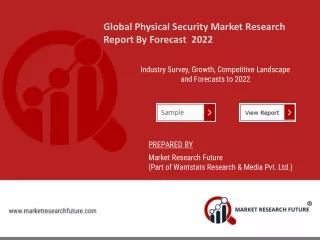
The global Physical Security market is valued at USD 143.5 Billion in 2023. The overall demand for physical security is expected to develop at an 7.9% CAGR over the forecast period from 2023 to 2032. global sales of physical security are anticipated to reach USD 278.1 Billion by 2032.<br><br>Read More - https://market.us/report/physical-security-market/

Physical Security Market
E N D
Presentation Transcript
Physical Security Market: Unlocking New Frontiers in Protection The global Physical Security market is valued at USD 143.5 Billion in 2023. The overall demand for physical security is expected to develop at an 7.9% CAGR over the forecast period from 2023 to 2032. global sales of physical security are anticipated to reach USD 278.1 Billion by 2032 Read More - https://market.us/report/physical-security-market/ Introduction The physical security market is experiencing significant growth, driven by the increasing need for protection against both physical and cyber threats. Key growth factors include the rising incidence of terrorism, the surge in criminal activities, and the growing need for stringent security measures in public and private sectors. Technological advancements, such as the integration of artificial intelligence and IoT in security systems, are also propelling market expansion. However, challenges such as high initial investment costs, privacy concerns, and the complexity of integration with existing systems pose obstacles.
Opportunities for new entrants lie in innovative solutions that address these challenges, particularly in areas like cloud-based security services, smart city initiatives, and customized security solutions for various industries. Emerging Trends 1. AI and Machine Learning Integration: Enhancing the accuracy and efficiency of security systems through real-time threat detection and response. 2. Cloud-Based Security Solutions: Offering scalable, cost-effective, and easily upgradable security systems. 3. Biometric Authentication: Increasing adoption of fingerprint, facial recognition, and iris scanning for secure access control. 4. Drones and Robotics: Utilizing drones and autonomous robots for surveillance and patrolling, especially in large and complex areas. 5. IoT-Enabled Security Systems: Providing interconnected devices that offer comprehensive and real-time monitoring and control. Top Use Cases 1. Critical Infrastructure Protection: Securing power plants, water treatment facilities, and other essential services against threats and attacks. 2. Commercial and Residential Security: Implementing advanced surveillance, access control, and alarm systems to protect properties. 3. Public Safety and Urban Security: Enhancing security in public places, transportation hubs, and smart cities through integrated systems. 4. Banking and Financial Institutions: Ensuring the security of assets, data, and personnel in financial institutions with robust security measures. 5. Healthcare Facilities: Protecting patients, staff, and sensitive information in hospitals and clinics through advanced security solutions. Major Challenges 1. High Initial Costs: The substantial investment required for the installation and maintenance of advanced security systems. 2. Privacy Concerns: Balancing the need for security with individuals' privacy rights and data protection regulations. 3. Technological Integration: Difficulty in integrating new security technologies with existing legacy systems. 4. Cybersecurity Threats: Ensuring that physical security systems are also protected against cyber-attacks and vulnerabilities.
5. Regulatory Compliance: Navigating complex regulatory environments and ensuring compliance with varying local and international standards. Market Opportunity 1. Smart Cities: The development of smart cities offers immense opportunities for advanced and integrated physical security solutions. 2. SMEs: Small and medium-sized enterprises represent a growing market for cost-effective and scalable security solutions. 3. Healthcare: Increasing demand for security solutions in healthcare facilities to protect sensitive patient information and ensure safety. 4. Retail Sector: Adoption of advanced security measures in retail to prevent theft, fraud, and ensure customer safety. 5. Industrial Security: Securing industrial facilities, warehouses, and supply chains against theft, vandalism, and other threats. Conclusion The physical security market is poised for substantial growth, driven by the increasing need for comprehensive security solutions across various sectors. Emerging trends such as AI integration, cloud-based solutions, and biometric authentication are shaping the future of the industry. Despite challenges like high costs and privacy concerns, the market offers significant opportunities for new entrants, particularly in smart city initiatives, SMEs, healthcare, retail, and industrial security. By leveraging innovative technologies and addressing key challenges, businesses can capitalize on the expanding demand for advanced physical security systems.