Download
1 / 6
60 likes | 194 Vues
In a world where wisdom and power dominate, Paul boldly proclaims the message of a crucified Savior, challenging the values of both Jews seeking a glorious kingdom and Greeks craving eloquent speech. He emphasizes how God chose the weak and despised to confound the wise, illustrating that true understanding comes only through the Spirit. This exploration reveals the essence of Paul’s teachings, highlighting the “foolishness” of the Gospel that, despite its simplicity, provides profound transformation for those who embrace it.

E N D
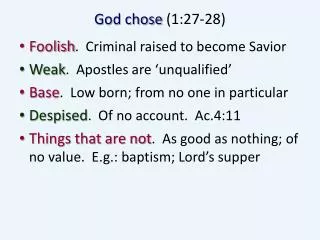
God chose (1:27-28) • Foolish. Criminal raised to become Savior • Weak. Apostles are ‘unqualified’ • Base. Low born; from no one in particular • Despised. Of no account. Ac.4:11 • Things that are not. As good as nothing; of no value. E.g.: baptism; Lord’s supper
Paul’s Corinthian audience (2:1-4) • Jews wanted a sign (1:22), a Messiah to restore their glorious kingdom • Paul preaches – • The Messiah has already come • He was crucified • Greeks wanted wisdom / oratory (1:22; 2:1-4); Paul offers no philosophy • Paul preaches – • Plain message • ‘Foolish’ message
Paul’s message (2:1-4) • Plain, 1 (no emphasis on oratory) • Foolish, 2 (not ‘customer oriented’) • Modern man cannot understand Roman world’sdisgust for crucifixion • Who would worship a crucified man? • Paul would not distract listeners atten-tion from his message to his manner • Humility, 3. 15:9-10 • Powerful, 4. 1:18
‘Comparing spiritual thingswith spiritual’(2:13) 1. Combine (ASV; NASB) 2. Compare (2 Co.10:12) (KJV; NKJV) 3. Explain, interpret (ESV; NRSV; SEB) (LXX: Gn.40:8, 16, etc.) No wonder Paul rejected excellencyof man’s speech & wisdom • This is verbal inspiration • This is plenary verbal inspiration
‘Natural Man’ (2:14) ‘Foolishness’ to hisnatural insight 1. Unconverted? 2. Uninspired? 3. W/o Spirit • Natural man does notreceiveSpirit’s teaching(Lk.8:13; Ac.8:14; 11:1; Ja.1:21) • Describes typical Greek wise man of the world – has all he needs in nature • Revelation is foolish; he rejects it • Jude 19; Ro.1:18, 23; Jn.6:60-66
‘Spiritual Man’ (2:15-16) 1. Judges all things, 15 (understands these things). 2. Natural man cannot understand him, 14 (cf. 4:3-4)…condemns what / who he does not understand (15). 3. He has the mind of Christ, 16 (Ph.2:5).