LL Parsing in Syntax Analysis
690 likes | 720 Vues
Learn about top-down LL parsing, syntax error checking, lexical analysis, and syntax tree structure in the context of syntactic and semantic analysis using CS 540 materials from George Mason University.


LL Parsing in Syntax Analysis
E N D
Presentation Transcript
Lecture 4: LL Parsing CS 540 George Mason University
Parsing Syntatic/semantic structure Syntatic structure tokens Scanner (lexical analysis) Parser (syntax analysis) Semantic Analysis (IC generator) Code Generator Source language Target language Code Optimizer • Syntax described formally • Tokens organized into syntax tree that describes structure • Error checking Symbol Table CS 540 Spring 2010 GMU
Top Down (LL) Parsing P P begin SS end SS S ; SS SS e S simplestmt S begin SS end begin simplestmt ; simplestmt ; end CS 540 Spring 2010 GMU
Top Down (LL) Parsing P P begin SS end SS S ; SS SS e S simplestmt S begin SS end SS begin simplestmt ; simplestmt ; end CS 540 Spring 2010 GMU
Top Down (LL) Parsing P P begin SS end SS S ; SS SS e S simplestmt S begin SS end SS SS S begin simplestmt ; simplestmt ; end CS 540 Spring 2010 GMU
Top Down (LL) Parsing P P begin SS end SS S ; SS SS e S simplestmt S begin SS end SS SS S begin simplestmt ; simplestmt ; end CS 540 Spring 2010 GMU
Top Down (LL) Parsing P P begin SS end SS S ; SS SS e S simplestmt S begin SS end SS SS SS S S begin simplestmt ; simplestmt ; end CS 540 Spring 2010 GMU
Top Down (LL) Parsing P P begin SS end SS S ; SS SS e S simplestmt S begin SS end SS SS SS S S begin simplestmt ; simplestmt ; end CS 540 Spring 2010 GMU
Top Down (LL) Parsing P beginSSend beginS; SS end beginsimplestmt;SSend beginsimplestmt; S ; SS end beginsimplestmt; simplestmt ; SSend beginsimplestmt; simplestmt ; end P begin SS end SS S ; SS SS e S simplestmt S begin SS end 1 P 2 SS 4 SS 3 SS 6 S 5 S e begin simplestmt ; simplestmt ; end CS 540 Spring 2010 GMU
Grammar S S S a B | b C B b b C C c c Two strings in the language: abbcc and bcc Can choose between them based on the first character of the input. b C a B c c b b C c c CS 540 Spring 2010 GMU
LL(k) parsing also known as the lookahead • Process input k symbols at a time. • Initially, ‘current’ non-terminal is start symbol. • Algorithm • Loop until no more input • Given next k input tokens and ‘current’ non-terminal T, choose a rule R (T …) • For each element X in rule R from left to right, if X is a non-terminal, we will need to ‘expand’ X else if symbol X is a terminal, see if next input symbol matches X; if so, update from the input • Typically, we consider LL(1) CS 540 Spring 2010 GMU
Two Approaches • Recursive Descent parsing • Code tailored to the grammar • Table Driven – predictive parsing • Table tailored to the grammar • General Algorithm Both algorithms driven by the tokens coming from the lexer. CS 540 Spring 2010 GMU
Writing a Recursive Descent Parser • Generate a procedure for each non-terminal. Use next token from yylex() (lookahead) to choose (PREDICT) which production to ‘mimic’. • for non-terminal X, call procedure X() • for terminals X, call ‘match(X)’ Ex: B b C D B() { if (lookahead == ‘b’) { match(‘b’); C(); D(); } else … } CS 540 Spring 2010 GMU
Writing a Recursive Descent Parser Also need the following: match(symbol) { if (symbol == lookahead) lookahead = yylex() else error() } main() { lookahead = yylex(); S(); /* S is the start symbol */ if (lookahead == EOF) then accept else reject } error() { … } CS 540 Spring 2010 GMU
S() { if (lookahead == a ) { match(a);B(); } S a B else if (lookahead == b) { match(b); C(); } S b C else error(“expecting a or b”); } B() { if (lookahead == b) {match(b); match(b); C();} B b b C else error(); } C() { if (lookahead == c) { match(c) ; match(c) ;} C c c else error(); } Back to grammar CS 540 Spring 2010 GMU
Parsing abbcc S abbcc Remaining input: Call S() from main() S() { if (lookahead == a ) { match(a);B(); } S a B else if (lookahead == b) { match(b); C(); } S b C else error(“expecting a or b”); } CS 540 Spring 2010 GMU
Parsing abbcc S bbcc Remaining input: a B Call B() from A(): B() { if (lookahead == b) {match(b); match(b); C();} B b b C else error(); } CS 540 Spring 2010 GMU
Parsing abbcc S cc Remaining input: a B Call C() from B(): C() { if (lookahead == c) { match(c) ; match(c) ;} C c c else error(); } b b C CS 540 Spring 2010 GMU
Parsing abbcc S Remaining input: a B b b C c c CS 540 Spring 2010 GMU
How do we find the lookaheads? • Can compute PREDICT sets from FIRST and FOLLOW for LL(1) parsing: • PREDICT(A a) = (FIRST(a) – {e}) FOLLOW(A) if e in FIRST(a) = FIRST(a) if e not in FIRST(a) NOTE: e never in PREDICT sets For LL(k) grammars, the PREDICT sets for the productions associated with a given non-terminal must be disjoint. CS 540 Spring 2010 GMU
Example FIRST(F) = {(,id} FIRST(T) = {(,id} FIRST(E) = {(,id} FIRST(T’) = {*,e} FIRST(E’) = {+,e} FOLLOW(E) = {$,)} FOLLOW(E’) = {$,)} FOLLOW(T) = {+$,)} FOLLOW(T’) = {+,$,)} FOLLOW(F) = {*,+,$,)} Assume E is the start symbol CS 540 Spring 2010 GMU
E() { if (lookahead in {(,id } ) { T(); E_prime(); } E T E’ else error(“E expecting ( or identifier”); } E_prime() { if (lookahead in {+}) {match(+); T(); E_prime();} E’ + T E’ else if (lookahead in {),end_of_file}) return; E’ e else error(“E_prime expecting +, ) or end of file”); } T() { if (lookahead in {(,id}) { F(); T_prime(); } T F T’ else error(“T expecting ( or identifier”); } CS 540 Spring 2010 GMU
T_prime() { if (lookahead in {*}) {match(*); F(); T_prime();} T’ * F T’ else if (lookahead in {+,),end_of_file}) return; T’ e else error(“T_prime expecting *, ) or end of file”); } F() { if (lookahead in {id}) match(id); F id else if (lookahead in {(} ) { match( ( ); E(); match ( ) ); } F ( E ) else error(“F expecting ( or identifier”);} CS 540 Spring 2010 GMU
Parsing a + b * c E Remaining input: a+b*c CS 540 Spring 2010 GMU
Parsing a + b * c E Remaining input: a+b*c T E’ E() { if (lookahead in {(,id } ) { T(); E_prime(); } else error(“E expecting ( or identifier”); } CS 540 Spring 2010 GMU
Parsing a + b * c E Remaining input: a+b*c TE’ F T’ T() { if (lookahead in {(,id } ) { F(); T_prime(); } else error(“T expecting ( or identifier”); } CS 540 Spring 2010 GMU
Parsing a + b * c E Remaining input: +b*c TE’ FT’ F() { if (lookahead in {id } ) match(id) else if (lookahead in { ( } { match( ( ); E(); match( ) ); } else error(“F expecting ( or identifier”); } id a CS 540 Spring 2010 GMU
Parsing a + b * c E Remaining input: +b*c TE’ F T’ T_prime() { if (lookahead in {*}) {match(*); F(); T_prime();}’ else if (lookahead in {+,),end_of_file}) return; else error(“T_prime expecting *, ) or end of file”); } } id a e CS 540 Spring 2010 GMU
Parsing a + b * c E Remaining input: b*c T E’ F T’ +T E’ E_prime() { if (lookahead in {+}) {match(+); T(); E_prime();}’ else if (lookahead in {),end_of_file}) return; else error(“E_prime expecting *, ) or end of file”); } } id a e CS 540 Spring 2010 GMU
Parsing a + b * c E Remaining input: b*c T E’ F T’ +TE’ T() { if (lookahead in {(,id } ) { F(); T_prime(); } else error(“T expecting ( or identifier”); } id a F T’ e CS 540 Spring 2010 GMU
Parsing a + b * c E Remaining input: *c T E’ F T’ +TE’ F() { if (lookahead in {id } ) match(id) else if (lookahead in { ( } { match( ( ); E(); match( ) ); } else error(“F expecting ( or identifier”); } id a F T’ e id b CS 540 Spring 2010 GMU
Parsing a + b * c E Remaining input: c T E’ F T’ +T E’ T_prime() { if (lookahead in {*}) {match(*); F(); T_prime();}’ else if (lookahead in {+,),end_of_file}) return; else error(“T_prime expecting *, ) or end of file”); } } id a F T’ e id b *F T’ CS 540 Spring 2010 GMU
Parsing a + b * c E Remaining input: T E’ F T’ +TE’ F() { if (lookahead in {id } ) match(id) else if (lookahead in { ( } { match( ( ); E(); match( ) ); } else error(“F expecting ( or identifier”); } id a F T’ e id b *F T’ id c CS 540 Spring 2010 GMU
Parsing a + b * c E Remaining input: T E’ F T’ +TE’ T_prime() { if (lookahead in {*}) {match(*); F(); T_prime();}’ else if (lookahead in {+,),end_of_file}) return; else error(“T_prime expecting *, ) or end of file”); } } id a F T’ e id b * F T’ e id c CS 540 Spring 2010 GMU
Parsing a + b * c E Remaining input: T E’ F T’ + T E’ E_prime() { if (lookahead in {+}) {match(+); T(); E_prime();}’ else if (lookahead in {),end_of_file}) return; else error(“E_prime expecting *, ) or end of file”); } } id a F T’ e e id b * F T’ e id c CS 540 Spring 2010 GMU
Stacks in Recursive Descent Parsing E • Runtime stack • Procedure activations correspond to a path in parse tree from root to some interior node E’ T F id b CS 540 Spring 2010 GMU
Two Approaches • Recursive Descent parsing • Code tailored to the grammar • Table Driven – predictive parsing • Table tailored to the grammar • General Algorithm Both algorithms driven by the tokens coming from the lexer. CS 540 Spring 2010 GMU
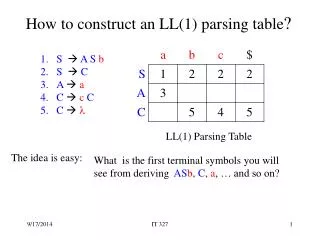
LL(1) Predictive Parse Tables An LL(1) Parse table is a mapping T: Vn x Vt production P or error • For all productions A a do For each terminal t in Predict(A a), T[A][t] = A a • Every undefined table entry is an error. CS 540 Spring 2010 GMU
Using LL(1) Parse Tables ALGORITHM INPUT: token sequence to be parsed, followed by ‘$’ (end of file) DATA STRUCTURES: • Parse stack: Initialized by pushing ‘$’ and then pushing the start symbol • Parse table T CS 540 Spring 2010 GMU
Algorithm: Predictive Parsing similar to ‘match’ push($); push(start_symbol); lookahead = yylex() repeat X = pop(stack) if X is a terminal symbol or $ then if X = lookahead then lookahead = yylex() else error() else /* X is non-terminal */ if T[X][lookahead] = X Y1 Y2 …Ym push(Ym) … push (Y1) else error() until X = $ token similar to ‘mimic’ CS 540 Spring 2010 GMU
Example CS 540 Spring 2010 GMU
Assume E is the start symbol CS 540 Spring 2010 GMU