Coronal Dimming Analysis of the 13th May 2005 Solar Event
130 likes | 266 Vues
This analysis explores the complex coronal dimming associated with the solar event of 13th May 2005, which occurs following a solar maximum and is influenced by residual magnetic fields. Unlike the simpler 12th May 1997 event, the 2005 event presents a more intricate pattern of coronal dimming, characterized by intensity variations and gaps in data. The study investigates factors like pre-eruption loops and the role of coronal holes in shaping the eruption's footprint. Insights into dimming evolution provide vital information on the coronal mass ejection's magnetic topology.


Coronal Dimming Analysis of the 13th May 2005 Solar Event
E N D
Presentation Transcript
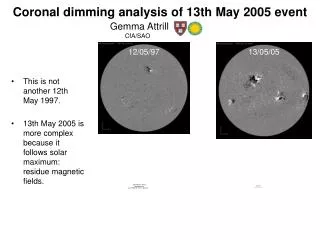
Coronal dimming analysis of 13th May 2005 event Gemma Attrill CfA/SAO 12/05/97 13/05/05 • This is not another 12th May 1997. • 13th May 2005 is more complex because it follows solar maximum: residue magnetic fields.
2 5 4 3 1 6 7 8 Intensity 7 8 1 3 2 Time Away from core 1 5 4 Away from core 2 6 Data gap: 17:37 - 22:58 UT Intensity evolution (35 hr) selected regions Quiet Sun Coronal Hole
Existing coronal hole and extended dimming Previous rotation 17th April Post-eruption:13th May Pre-eruption 13th May Extended CH is there all the time. But obscured by overlying loops pre-eruption. These loops are removed during the eruption.
7 8 1 3 2 5 4 6 Old MDI data - not recalibrated: How are these loops involved in the eruption? • Do they play a crucial role in making the footprint of the eruption so large-scale? • Need to understand remote, secondary dimmings too.
Small clues… Plus global-scale coronal wave too!
Verification: 10th April 8th May
Dimming analysis 13/05/05 Gemma Attrill Mullard Space Science Laboratory This is not another 12/05/97. 13/05/05 is more complex because it follows solar maximum: residue magnetic fields. 12/05/97 13/05/05
Attrill et al., (2006) Selecting regions for analysis
2 5 4 3 1 6 7 8 Intensity 7 8 1 3 2 Time Away from core 1 5 4 Away from core 2 6 Data gap: 17:37 - 22:58 UT Intensity evolution (35 hr) selected regions Quiet Sun Coronal Hole
7 8 1 3 2 5 4 6 Magnetic flux dimmings (20 G filter) If dimmings 1 and 2 mark flux rope footpoints, then minimum magnetic flux of the flux rope: ((Absolute 1 + Absolute 2) / 2) = 3.98E+21 Mx c.f. Yurchyshyn et al., (2006) use an Erupting Flux Rope model and Hu et al., (2006) use the Grad-Shafranov model: Axial (torroidal) flux in ICME = 2.9E+21 Mx, 2.1E+21 Mx Azimuthal (poloidal) flux in ICME = 4.4E+22 Mx, 4.2E+21 Mx Our magnetic flux measurement (which is a minimum), is too large to be explained just by the axial (torroidal) magnetic flux. So the azimuthal (poloidal) magnetic flux is also required.
3 1 2 4 7 7 8 1 3 2 5 4 6 From SolarSoft Latest events archive. PFSS Derosa & Schrijver How do the dimmings form? Analysis of the evolution of the dimmings can give a lot of information (both quantitative & qualitative) regarding the changing magnetic topology of the CME event.