Understanding Acids, Bases, and Titration Reactions: Definitions and Calculations
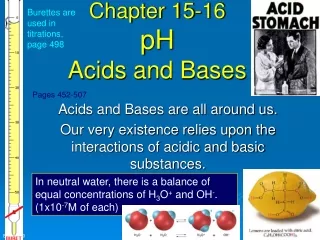
This chapter delves into the fundamental concepts of acids and bases, exploring definitions based on Arrhenius and Brønsted-Lowry theories. It explains the dissociation of water, how to interpret pH, and the relationship between acidity and basicity through conjugate pairs. Additionally, the chapter covers practical calculations for strong acids and bases, including pH and pOH, as well as titration problems involving sulfuric acid and sodium hydroxide. Readers will gain hands-on experience with real-world applications in acid-base chemistry.

Understanding Acids, Bases, and Titration Reactions: Definitions and Calculations
E N D
Presentation Transcript
Chapter 15 - Acids and Bases Plus titration reactions from chapter 3
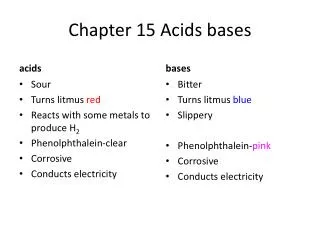
Arrhenius Definitions • Acid - Proton donor HA H+ + A- • HCl H+ + Cl- • Base - Hydroxide donor MOHM+ + OH- • KOHK+ + OH-
Brønsted Lowry • Acid - Proton donor HA + H2O H3O+ + A- • HCl + H2O H3O+ + Cl- • Base - Proton acceptor B: + H2O BH+ + OH- • NH3 + H2O NH4+ + OH-
HA + B <==> BH+ + A- acid base acid base Conjugate acid/ base pairs differ by 1 proton.
Protons in water • We write HA <=> H+ + A- • but H+ is never found by itself -- in aqueous solutions it joins with H2O to form H3O+ • So when we write [H+] we really mean [H3O+].
Acid Strength • Strong acid weak conjugate base • Weak acid strong conjugate base • Strong base weak conjugate acid • Weak base strong conjugate acid • Makes sense -- if an acid gives up a proton easily, then its conjugate base is probably not very good at grabbing protons.
Dissociation of Water • 2 H2O <==> H3O+ + OH- • K = [H3O+][OH-]/ [H2O]2 • the concentration of water is ~ 55M and can be treated as a constant. • so Kw = K[H2O]2 = [H3O+][OH-] = 1.0 x 10⁻¹⁴ M2
Definition of pH • pH = -log [H+] = -log [H3O+] • so if [H3O+] = 2.48 x 10⁻⁴ then pH = -log 2.48 x 10-4 = 3.606
[H3O+] = 10-pH • so if pH = 9.431 then [H3O+] = 10-9.431 = 3.707 x 10⁻¹⁰ M
Calculating pH and pOH for strong acids and bases • For strong acids and bases • [H+] = [acid] acidic protons/ molecule • [OH-] = [base] hydroxides/ molecule
The strong acids and bases are • Strong acids Strong bases • HClO4 NaOH • HCl KOH • HBr soluble hydroxides • HI • H2SO4 • HNO3
Remember • pH = -log [H3O+] • pOH = -log [OH-] • [H3O+] [OH-] = 1.0 x 10⁻¹⁴ • pH + pOH = 14
What are the values of [H3O+], [OH-], pH, and pOH for a 4.287 x 10⁻⁴ M solution of Ca(OH)2?
[OH-] = 2(4.287 x 10⁻⁴ M) = 8.574 x 10⁻⁴ M • pOH = -log [OH-] = -log 8.574 x 10-4 = 3.0668 • pH = 14 - pOH = 14 - 3.067 = 10.9332 • [H3O+] = 10-10.9332 = 1.166 x 10⁻¹¹ M
If 350.0 mL of 0.1283 M sulfuric acid is mixed with 250.0 mL of 0.2899 M sodium hydroxide, what will be the pH of the solution?
A noncarbonated soft drink contains an unknown amount of citric acid, H3C6H5O7. If 100.0 mL of the soft drink requires 33.51 mL of 0.01024 M NaOH to neutralize the citric acid completely, what is the concentration of citric acid in the soft drink in moles/liter (M)? In equivalents/liter (N)?
Suppose you are given a 4.554 g sample that is a mixture of oxalic acid, H2C2O4, and another solid that does not react with sodium hydroxide. If 29.58 mL of 0.550 M NaOH is required to titrate the oxalic acid in the 4.554 g sample, what is the weight percent of oxalic acid in the mixture?
A vitamin C tablet was analyzed to determine whether it did in fact contain, as the manufacturer claimed, 1.00 g of the vitamin. A tablet was dissolved in water to form a 100.00 mL solution, and a 10.00 mL sample was titrated with iodine (as KI3, potassium triiodide). It required 10.10 mL of 0.0521 M I3-1 to reach the stoichiometric point in the titration. Given that vitamin C, C6H8O6, is oxidized todehydroascorbic acid, C6H6O6 and triiodide, I3-1, is oxidized to iodide, I-1, write a balanced equation for the reaction and determine whether the manufacturer’s claim is correct? (MW vitamin C = 176 g/mol)
A 35.49 mL sample of 0.2430 M H2SO4 is mixed with 65.33 mL of a 0.4199 M sample of KOH. Determine the concentration of all ions in solution, the pH, and pOH.