Globalization
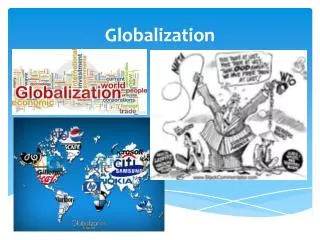
Globalization is the process of increasing interconnectedness among nations, fueled by technological innovation and free-market practices since the 1980s. This overview examines key aspects of globalization, including economic growth, foreign direct investment (FDI), and the role of multinational corporations (MNCs). It addresses major controversies relating to trade, environment, societal inequality, and culture. While globalization offers benefits such as specialized labor and access to new technologies, it also presents challenges, including rising unemployment in certain sectors and growing income inequality.

Globalization
E N D
Presentation Transcript
Globalization By: Allison Chen
Overview • “Globalization is a process that results in the growing interconnectedness of the world” • Driven by technological innovations • Effects similar to chaos theory
Main Controversies • Trade • Environment • Media • Development • Women • Investment • International law • Technology • Culture • Migration • Human rights • Energy • Education • Health
Economic Globalization • Accelerated in 1980s and 1990s free-market economic systems • Reductions in barriers to commerce and international agreements • Growth and development levels increase higher wages, shift from labor-intensive to more capital and knowledge intensive industry • Foreign direct investment (FDI): measure of foreign ownership of productive assets, such as factories, mines and land • Largest form of private capital inflow to developing countries • Brings technical information, jobs, and transmission of ideas • Most direct effect on people through their work and employment • Local markets exposed to global competition
Multinational Corporations • Multinational corporation (MNC): a business organization whose activities is located in multiple countries and is the organizational form that defines FDI • Dominant role in trade and financial interactions globally • Creates competition between countries vying for investment • Political as well as economic force • Comprises one-third of the world’s exports • Inequality: wealth and strong bargaining position relative to the often poorer (and weaker) developing countries in which they invest
MNC Example: Nike, Inc. • Headquarters: Beaverton, Oregon • Development, marketing, and selling of athletic equipment • Manufacturing locations: 45 countries, factories mostly in Asia (Indonesia, China, Taiwan, Indian, Thailand, Vietnam, Pakistan, Philippines, and Malaysia) • Operates in 120 countries and has over 20,000 employees
Technology • Promotion of new products and ideas across nations and cultures channels to exchange information • Internet creates new ways to make transactions and run businesses • Individuals connect globally and collaborate on ideas and technological innovations
Inequality • Income gap between rich and poor nations increasing • Capital directed at capital-generating industrial sectors • Alienation, massive unrest, and political and social instability • Spending directed away from social welfare and towards export sectors • Race to the bottom: a dynamic whereby companies seek the lowest level of regulation and taxation lowering of standards of labor, human rights, and environmental protection
Global Governance • Creation of global institutions (ex. IMF, WTO, WHO, and World Bank) • Loss of national sovereignty in certain issues • Treaties are strongest and most binding type of law • International Court of Justice (UN): settles legal disputes • Enforced through reciprocity, shaming, and collective action
Environment • Global warming caused by fossil fuel combustion, the burning of forests, and biomass combustion • Produce halogens (carbon dioxide, methane, etc.) • Ozone depletion • Exploit resources of countries with little regard to environmental cost • Illegal international wildlife trafficking • Spread of invasive species
Cultural Globalization • Diffusion of Western culture • Defense of local and traditional cultures • Languages countries trying to protect languages from the immigration of foreign words • Democratization • Entertainment translated into multiple languages
Benefits of Globalization • Allows for countries to specialize: labor, natural resources, and technology • Increases the variety of goods and services available • Increased competition spurs domestic firms to invest in equipment and software embodied with the latest technologies • Poor countries provided access to new ideas and technologies
Downside of Globalization • Creates people in certain industries who cannot compete with foreign manufacturers • Move production overseas for cheaper labor, creating increased unemployment • Rising income inequality between the low-skilled and high-skilled workers