CHEMICAL REACTIONS
110 likes | 240 Vues
Chemical reactions transform one set of chemicals into another, involving reactants that undergo bond breaking and forming during the process. Energy changes are central to these reactions, with some releasing energy spontaneously, while others absorb energy, requiring activation energy to initiate. Catalysts, including enzymes, enhance reaction rates by lowering activation energy. Enzymes provide specific sites for reactants, ensuring efficient reactions in biological systems. Their activity can be influenced by factors like pH and temperature, playing a crucial role in sustaining life by facilitating essential biochemical processes.


CHEMICAL REACTIONS
E N D
Presentation Transcript
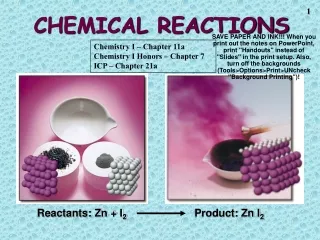
CHEMICAL REACTIONS • Process which changes one set of chemicals into another set of chemicals. • Ex. Combining Iron (Fe) and Oxygen (O) to form Rust. • Reactants - elements or compounds that enter into a chemical reaction • Products - elements or compounds made by a chemical reaction. • Bonds are broken in reactants and formed in products.
CHEMICAL REACTIONS ALWAYS INVOLVE CHANGES IN ENERGY • REACTIONS THAT RELEASE ENERGY SOMETIMES HAPPEN SPONTANEOUSLY • REACTIONS THAT ABSORBENERGY MUST HAVE A SOURCE OF ENERGY • THE ENERGY NEEDED TO START A REACTION IS CALLED ACTIVATION ENERGY.
CATALYSTS • SUBSTANCES THAT SPEED UP RATE OF REACTION. • WORK BY LOWERING THE ACTIVATION ENERGY. • ENZYMES ARE PROTEINS THAT SPEED UP CHEMICAL REACTIONS IN CELLS. CAUSES THE REACTION TO TAKE PLACE BY LOWERING THE ACTIVATION ENERGY NEEDED. • EX. CO2 + H2O H2CO3 • Carbonic anhydrase
SPEED OF REACTIONS • LEFT ALONE MANY BIOLOGICAL REACTIONS WOULD HAPPEN TOO SLOWLY. • Example of an enzyme • CARBONIC ANHYDRASE CAUSES THE CHANGE INTO CARBONIC ACID TO HAPPEN QUICKLY. • ENZYMES ARE SPECIFIC AND USUALLY ONLY CATALYZE ONE REACTION.
ENZYME ACTION • REACTANTS IN CHEMICAL REACTIONS MUST HIT WITH ENOUGH FORCE TO BREAK OLD BONDS AND FORM NEW ONES • ENZYMES PROVIDE THE PLACE WHERE REACTANTS ARE BROUGHT TOGETHER REDUCING THE ENERGY NEEDED FOR THE REACTION TO OCCUR.
ENZYME SHAPE • SUBSTRATES - THE REACTANTS OF ENZYME CATALYZED REACTIONS • EACH PROTEIN HAS A SPECIFIC SHAPE. • ACTIVE SITE ON THE PROTEIN HAS A COMPLIMENTARY SHAPE TO THE SUBSTRATE. • ENZYME AND PROTEIN FIT TOGETHER LIKE PUZZLE PIECES. • SEE PG. 52 • ENZYMES ARE REUSABLE.
ENZYME ACTIVITY • AFFECTED BY Ph • Many biological enzymes function best at a pH of 7 • Most biological enzymes function best at normal human body temp. • Few enzymes function well at high temperature
Activation Energy • What significance do these energy changes have to do with living things? In order to stay alive, organisms need to carry out reactions that require energy.
Regulation of Enzyme Activity • Because they are catalysts for reactions, enzymes can be affected by any variable that influences a chemical reaction. • Many enzymes are affected by temp, pH, etc.
http://www.youtube.com/watch?v=V4OPO6JQLOE&list=FLos62yqwp6aQmbJI7D_f7CA&index=46&feature=plpp_videohttp://www.youtube.com/watch?v=V4OPO6JQLOE&list=FLos62yqwp6aQmbJI7D_f7CA&index=46&feature=plpp_video • Difference between no enzyme and enzyme in solution Awesome Animation • http://www.whfreeman.com/catalog/static/whf/thelifewire6e/con_index.htm?99xex • How enzymes work in the body! • http://highered.mcgraw-hill.com/sites/9834092339/student_view0/chapter3/enzyme_action_and_the_hydrolysis_of_sucrose.html