Download
1 / 60
600 likes | 698 Vues
Explore the impact of the Industrial Revolution on American society, urbanization, transportation, and sectionalism. Learn about key figures like Henry Clay and John C. Calhoun, and the landmark Supreme Court cases that expanded federal power. Discover how the era of good feelings shaped national unity and the Monroe Doctrine protected Latin American nations.

E N D
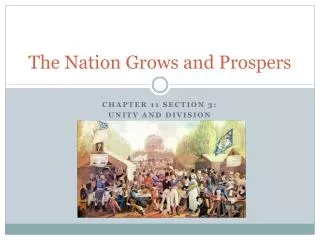
The Nation Grows and Prospers U.S. History Chapter 11
Industrial Revolution Begins • Industrial Revolution was a long, slow process that completely changed the way in which goods were produced. • Began in Britain in mid-1700s
Industrial Revolution Begins • This industrialism depended on the development of the factory system
Factory System • System brought workers and machinery together to produce goods • Lowell, Mass.: model factory town, workers lived in clean, decent housing
Factory System • “Lowell girl”: worked in factory but returned home to marry • Workers, primarily women and children, worked long hours: 12 hours/day, 6 days/week
American Industry • Congress helped industry after the War of 1812 by establishing the second Bank of the United States • Congress also protected manufacturers by raising tariffs on imported goods
Urbanization • Industrial Revolution led to increased U.S. urbanization • Population moved from the rural farming areas to the cities
Urbanization • New York City became the city with the largest population in 1840
Industrial Revolution Cause-Effect • Led to greater U.S. economic development • Urbanization of the U.S.
Traveling West • Private companies built turnpikes to improve America’s roads in early 1800s • Tolls collected from travelers on the turnpikes • Improved roads were set on a bed of gravel
Traveling West • Mohawk Road followed Erie Canal • National Road extended from Maryland into Illinois • Wilderness Road, established by Daniel Boone, reached the Ohio River
Traveling West • Development of canals allowed western farmers to ship goods directly to eastern cities.
Era of Good Feelings • President James Monroe helped create a new sense of national unity. • Federalist Party disappeared by 1820. Monroe ran for a 2nd term unopposed.
Sectionalism • Loyalty to one’s state or section rather than to the nation as a whole. • Made national unity more difficult
Henry Clay • Spoke for the West • Wanted to promote economic growth for all sections: American System
Henry Clay • American System failed: Congress refused to fund new roads, bridges, and canals. • Unintentionally furthered growth of sectionalism
John C. Calhoun • Spoke for the South • As a southerner, he supported slavery
Industrial Revolution Cause-Effect • Improved roads leading to western growth of the nation • Sectionalism beginning to threaten national unity
Supreme Court Expands • McCulloch v. Maryland (1819) • Court ruled that states had no power to control federal institutions within their borders. • Strengthened federal power
Supreme Court Expands • Gibbons v. Ogden (1824) • Only federal government has the power to regulate interstate commerce, or trade between states
Supreme Court Expands • Gibbons v. Ogden (1824) • Court ruled that that a state could regulate trade only within its own borders.
New Nations in the Americas • Creole: People born to Spanish parents in Latin America • Creoles demanded a role in government • Opposition to Spain was growing
Revolution in Latin America • Spanish colonies had to win independence through revolution • Led to rise of Latin American nations
Revolution in Latin America • Simon Bolivar: best known revolutionary leader, The Liberator • Led successful independence movements in South America
Spain Gives Up Florida • Spain agreed to sell Florida to the U.S. for $5 million • Spain busy fighting rebels in South America • Adams-Onis Treaty: 1821
Monroe Doctrine • Americans feared that Spain would try to regain its colonies in Latin America
Monroe Doctrine • President Monroe’s foreign policy statement to protect Latin American republics from European attack
Monroe Doctrine • Declared that the U.S. would not interfere in the affairs of European nations or existing colonies of European nations
Monroe Doctrine • Warned European nations not to attempt to regain control of the newly independent nations of Latin America
Monroe Doctrine • United States was determined to keep European powers out of the Western Hemisphere.
Monroe Doctrine • U.S. successfully challenged European intervention, or direct involvement, in Latin America.
Can you answer these questions? • If not, look back over this review!
Review • Who is someone born in Latin America to Spanish parents? • Lowell girl • Capitalist • creole
Review • What is direct involvement by one nation in the affairs of another? • Urbanization • Sectionalism • Intervention
Review • What was an unintended result of Henry Clay’s American system? • Much money was spent on transportation • Further growth of sectionalism • High tariffs
Review • Who was someone who worked in the mills and returned home to marry? • Capitalist • Lowell girl • Creole
Review • What is loyalty to one’s state or region? • Urbanization • Sectionalism • Intervention
Review • How did Congress help American industry after the War of 1812? • It closed the first Bank of the United States • It established the second Bank of the United States • It lowered tariffs
Review • How did the United States gain Florida from Spain? • U.S. bought Florida for $5 million • U.S. won Florida after a lengthy battle with Spain • Spain gave up Florida as a result of the Monroe Doctrine
Review • Why was Lowell, Mass. Called a model factory town? • Factory owners shortened the employees’ work day • Factories employed young children • Workers lived in clean, decent housing
Review • What is one way Americans improved their roads in the early 1800s? • Private companies built turnpikes • Private companies put up funds for the National Road • During the War of 1812, the army built the National Road
Review • Why was Simon Bolivar known as “The Liberator?” • He led independence movements in South America • He led a revolt freeing Texas from Mexican rule • He persuaded Spain to free its Latin American colonies
Review • Which of the following describes the Industrial Revolution? • Depended on the development of the factory system • Occurred after years of planning in U.S. in 1700s • Was quick, violent and produced few results
Review • How did private companies finance turnpikes? • Campaigned for donations from people • Borrowed money from states where turnpikes crossed • Collected tolls from travelers
Review • Which of the following led to the creation of the Monroe Doctrine? • U.S. wanted to control Latin America • U.S. feared Spain would try to regain its colonies in Latin America • U.S. feared Britain would try to take over its original colonies.
Review • Which is the BEST interpretation of Supreme Court decision, McCullough v. Maryland? • Federal govt. cannot tax state institutions • States can nullify federal laws they think are unconstitutional • States have no power to control federal institutions within their borders
Review • What BEST describes daily life in a factory in the early 1800s? • Employees, mostly women & children, worked long hours • Factory owners more took interest in workers’ welfare • Laws were enacted to prevent child labor
Review • What effect did sectionalism have on the Era of Good Feelings? • It made national unity more difficult • It divided the nation into East and West • It weakened political parties
Review • What generalization can be made about the rise of Latin American nations? • Spain gave up control of its colonies • Colonies had to win independence through revolution • New republics easily achieved democratic rule.
Review • What was a result of the development of canals in the early 1800s? • Canals allowed western farmers to ship goods directly to eastern cities • Few farmers could afford to ship goods through canals • The National Road fell into disuse