Calculating Coefficients of Friction for Moving Objects
10 likes | 139 Vues
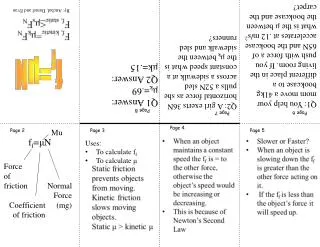
This document explores the calculations of the coefficient of friction (μ) for two different scenarios involving moving objects. In the first scenario, a 41kg bookcase is pushed across a carpet with a force of 65N and accelerates at 0.12 m/s², yielding a coefficient of friction of μk = 0.69. In the second scenario, a girl pulls a 52N sled with a horizontal force of 36N at a constant speed on a sidewalk, resulting in a coefficient of kinetic friction of μk = 0.15. These examples highlight basic principles of mechanics and friction in daily life.


Calculating Coefficients of Friction for Moving Objects
E N D
Presentation Transcript
Q1: You help your mom move a 41kg bookcase to a different place in the living room. If you push with force a of 65N and the bookcase accelerates at .12 m/s2 what is the μ between the bookcase and the carpet? By: Anchal, Daniel and Evan Q2: A girl exerts 36N horizontal force as she pulls a 52N sled across a sidewalk at a constant speed what is the μk between the sidewalk and sled runners? Q1 Answer: μk=.69 Q2 Answer: μk=.15 ff=μN Page 8 Page 7 Page 6 Page 4 Page 2 Mu Page 3 Page 5 ff=μN • Uses: • To calculate ff • To calculate μ Force of friction Normal Force (mg) Coefficient of friction