Classical Art of Greece: Influence and Expression
Explore the enduring influence of ancient Greece on contemporary societies, focusing on philosophy, aesthetics, sculpture, and architecture. Discover the balance between mind and body, naturalism, and idealism in Greek art.

Classical Art of Greece: Influence and Expression
E N D
Presentation Transcript
Classical Art Greece and Rome
Greece • Intellectual and creative influences still hold a place in contemporary societies • Attitudes toward life • Humanism • People the focus • Physically and mentally fit • Balance between mind and body • Balance between emotion and intellect • Naturalism • Truth based on observation of nature • Idealism • When nature fell short of perfection the Greeks turned toward an accepted standard of beauty
Greece • Birth place of Aesthetics • Aesthetics: a branch of philosophy dealing with the nature of beauty, art, and taste and with the creation and appreciation of beauty • Why was Aesthetics born in Greece? • Philosophy was born in Greece • They loved order and feared chaos and they saw order in art • High premium on the physical • Athletics • Advanced understanding of geometric forms • Wealth • Trade related • Communication skills • Trade related
Greece • Key figures in discussing aesthetics • Aristotle • Socrates • Plato
Greece • Periods • Geometric • Archaic • Classical • Hellenistic
Greece • Geometric • Shapes and patterns • Conceptual figures • Dipylon Vase • Terra-cotta • 42 5/8” tall • Grave marker • Figures: • Frontal view • Profile legs and arms • Profile head • Frontal eyes
Greece • Archaic • Figure replaced Geometric patterns • Francois Vase • Ceramic • 26” tall • Divided into 6 registers • Attempt at naturalism • Figures not static as in the Dipylon Vase • Handles actually echo design • Black-figure painting
Greece • Black-figure painting • Black figures on a reddish background • Figures painted on using a brush and slip • First fired in oxidation • Second fired in reduction • This pulled the red color out of the clay body • Then, finer details incised with sharp tool
Greece Doric • Archaic Architecture Ionic Corinthian
Greece • Sculpture • In the Archaic period, sculpture emerged as the principle art form • Freestanding, life-sized, and larger-than-life-sized • Influenced by Egyptians • Temples ornamented with sculptures • Frieze and pediment • Dying Warrior & Fallen Warrior • These works require the viewer to piece the drama together by collecting information from scattered realistic elements
Greece • Kouros figure • Marble • 6’4” tall • Devotional or funerary • Similar to Egyptian sculptures • Different though: • The stone was carved away from the body, releasing it from the block
Greece • Kore figure • Female counterpart of the kouros • Peplos is the heavy woolen wrap she is wearing • Touches of paint • Colors often used: • Red, blue, yellow, green, black and gold • Beauty lies in the lines of this work • Contour and implied
Greece • Classical • Early Classical • Classical • Late Classical • Hellenistic Art
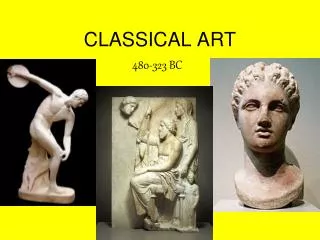
Greece • Early Classical • Diskobolos • Discus Thrower • Example of implied movement which was newly introduced in the Early Classical period • Idealized • However more realistic • Balance is key
Greece • Classical Art • Height of Greek Art • Arcitecture • Typical Greek temple
Rear Porch Cella Porch Colonnade Stylobate
Greece • The Parthenon • Dedicated to Athena the protector of Athens • Doric order • Stylobate is convex • The columns are tilted inward and swell and the midpoint • Used as Byzantine church, Roman Catholic church and mosque • Used as an ammunition dump by the Turks in their was against the Venetians • The cella was hit by a Venetian rocket
Sculpture • The Three Goddesses • Marble • 4’7” tall • From the Parthenon • Phidias • Characteristics • Weighty • Naturalistic poses • Realistic drapery • Folds are articulate • Thinner drapery clings to the body
Doryphoros • Spear Bearer • Marble • 6’6” tall • Weight-shift principle • Polykleito’sstlye
Noibid Painter • Red-figure • Argonaut Krater • Registers eliminated • Attempted realism • Outlining foreground, middle ground and background • Fails in the end • Placement of figures not correct • Scale • Still waiting on perspective
Hermes = messenger god Greece • Late Classical • Sculpture • Hermes and Dionysos • Marble • 7’1” • Praxiteles • Softer flesh • S curve Dionysos = god of wine
Apoxyomenos • Original in bronze • 6’6” tall • Lysippos • Introduced new canon of proportions the introduced a more slender and graceful figure • The viewer is forced to walk around the sculpture • Due to arm positions • S curve seems to spiral in this work
Hellenistic Art • Excessive and theatrical emotion • Use of illusion to heighten realism • Space around figures is treated as an extension of the viewer’s space • The Dying Gaul • Unlike The Fallen Warrior • It’s all there and relatively seamless • Blood pouring out of wounds • Head hangs • Overall body language