Energy Dynamics in LC Circuits: Capacitors and Inductors Explained
This lecture explores the fundamental concepts of energy in capacitors and inductors, drawing mechanical analogies to mass-spring systems. It highlights how LC circuits oscillate similarly to mass-spring systems, and delves into basic equations like the loop and power equations, as well as the conservation of energy. The solution to the loop equation is discussed, with an emphasis on initial phase angles and conditions. Additionally, the lecture includes insights on dampened oscillation in RLC circuits and the relationship between charge and current.

Energy Dynamics in LC Circuits: Capacitors and Inductors Explained
E N D
Presentation Transcript
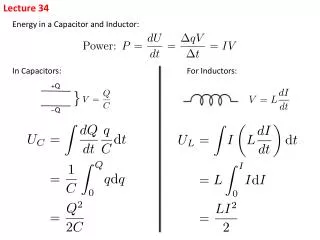
Lecture 34 Energy in a Capacitor and Inductor: In Capacitors: For Inductors:
Mechanical Analogy: Mass Spring System Corresponds to: LC circuits oscillate much in the same way a mass spring system oscillates
LC Circuit Basic Equations: Loop Equation: Power Equation: Conservation of Energy:
Solving the Loop Equation – Analogy to Mass-Spring System Solution: Comment: General Solution: (δ is the initial phase angle of the oscillation) Often set δ= 0, where at t = 0, the initial condition is chosen to be x = xmax
Check: where
RLC Circuit – Loop Equation Graph of Q and I of Dampened Oscillation: Each term can be positive or negative. PL + PC stays negative Always positive