Enhancing Software Process for Quality, Cost, and Schedule
This overview emphasizes the significance of a systematic approach to software engineering, focusing on industrial-strength software development. It outlines various essential processes, including project management, development, configuration management, and change management, all aimed at achieving high quality and productivity (Q&P). The discussion highlights methodologies for effective process execution, the importance of clear phase definitions, and the overall goal of delivering software within budget and schedule constraints. By focusing on structured processes, software projects can maximize efficiency and minimize errors.

Enhancing Software Process for Quality, Cost, and Schedule
E N D
Presentation Transcript
Software Process Sofware Process
Software Engineering • We have specified the problem domain – industrial strength software • Besides delivering the software, cost, quality, and schedule are drivers • Software engineering is defined as the systematic approach for development of (industrial strength) software Sofware Process
Process, People, Technology • Q&P is an essential goal • Q&P depends on people, process, and technology • Processes help people become more productive and create fewer errors • Tools help people execute some tasks in the process more efficiently and effectively • So, process forms the core Sofware Process
Software Process • Process is distinct from product – products are outcomes of executing a process on a project • SW Engg. focuses on process • Premise: Proper processes will help achieve project objectives of high QP Sofware Process
The software Development Problem Sofware Process
Project and Process • A software project is one instance of the development problem • Development process takes the project from user needs to software • There are other goals of cost schedule and quality, besides delivering software • Need other processes Sofware Process
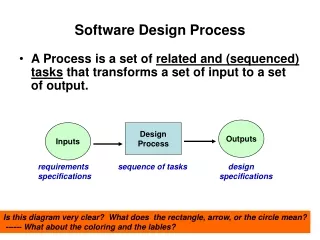
Software Process… • Process: A sequence of steps performed to achieve some goal • Software Process: The sequence of steps performed to produce software with high quality, within budget and schedule • Many types of activities performed by diff people in a software project • Better to view software process as comprising of many component processes Sofware Process
Component Software Processes • Two major processes • Development – focuses on development and quality steps needed to engineer the software • Project management – focuses on planning and controlling the development process • Development process is the heart of software process; other processes revolve around it • These are executed by different people • developers execute engg. Process • project manager executes the mgmt proces Sofware Process
Component Processes… • Other processes • Configuration management process: manages the evolution of artifacts • Change management process: how changes are incorporated • Process management process: management of processes themselves • Inspection process: How inspections are conducted on artifacts Sofware Process
Process Specification • Process is generally a set of phases • Each phase performs a well defined task and generally produces an output • Intermediate outputs – work products • At top level, typically few phases in a process • How to perform a particular phase – methodologies have been proposed Sofware Process
ETVX Specification • ETVX approach to specify a step • Entry criteria: what conditions must be satisfied for initiating this phase • Task: what is to be done in this phase • Verification: the checks done on the outputs of this phase • eXit criteria: when can this phase be considered done successfully • A phase also produces info for mgmt Sofware Process
ETVX approach Sofware Process
Development Process and Process Models Sofware Process
Software Project • Project – to build a sw system within cost and schedule and with high quality which satisfies the customer • Suitable process needed to reach goals • Process should not just help produce the software but help achieve the highest Q&P Sofware Process
Project’ s process and Process Models • For a project, the project’s process to be followed is specified during planning • A process model specifies a general process that is optimal for a class of problems • A project may select its process using one of the process models Sofware Process
Development Process • A set of phases and each phase being a sequence of steps • Sequence of steps for a phase - methodologies for that phase. • Why have phases • To employ divide and conquer • each phase handles a different part of the problem • helps in continuous validation Sofware Process
Development Process • Commonly has these activities: Requirements analysis, architecture, design, coding, testing, delivery • Different models perform them in different manner Sofware Process
Process Models • A process model specifies a general process, usually as a set of stages • This model will be suitable for a class of projects • I.e. a model provides generic structure of the process that can be followed by some projects to achieve their goals Sofware Process
Waterfall Model • Linear sequence of stages/phases • Requirements – HLD – DD – Code – Test – Deploy • A phase starts only when the previous has completed; no feedback • The phases partition the project, each addressing a separate concern Sofware Process
Waterfall… • Linear ordering implies each phase should have some output • The output must be validated/certified • Outputs of earlier phases: work products • Common outputs of a waterfall: SRS, project plan, design docs, test plan and reports, final code, supporting docs Sofware Process
Waterfall Advantages • Conceptually simple, cleanly divides the problem into distinct phases that can be performed independently • Natural approach for problem solving • Easy to administer in a contractual setup – each phase is a milestone Sofware Process
Waterfall disadvantages • Assumes that requirements can be specified and frozen early • May fix hardware and other technologies too early • Follows the “big bang” approach – all or nothing delivery; too risky • Very document oriented, requiring docs at the end of each phase Sofware Process
Waterfall Usage • Has been used widely • Well suited for projects where requirements can be understood easily and technology decisions are easy • I.e. for familiar type of projects it still may be the most optimum Sofware Process
Prototyping • Prototyping addresses the requirement specification limitation of waterfall • Instead of freezing requirements only by discussions, a prototype is built to understand the requirements • Helps alleviate the requirements risk • A small waterfall model replaces the requirements stage Sofware Process
Prototyping Sofware Process
Prototyping • Development of prototype • Starts with initial requirements • Only key features which need better understanding are included in prototype • No point in including those features that are well understood • Feedback from users taken to improve the understanding of the requirements Sofware Process
Prototyping • Cost can be kept low • Build only features needing clarification • “quick and dirty” – quality not important, scripting etc can be used • Things like exception handling, recovery, standards are omitted • Cost can be a few % of the total • Learning in prototype building will help in building, besides improved requirements Sofware Process
Prototyping • Advantages: req will be more stable, req frozen later, experience helps in the main development • Disadvantages: Potential hit on cost and schedule • Applicability: When req are hard to elicit and confidence in reqs is low; i.e. where reqs are not well understood Sofware Process
Iterative Development • Counters the “all or nothing” drawback of the waterfall model • Combines benefit of prototyping and waterfall • Develop and deliver software in increments • Each increment is complete in itself • Can be viewed as a sequence of waterfalls • Feedback from one iteration is used in the future iterations Sofware Process
Iterative Enhancement Sofware Process
Iterative Development • Products almost always follow it • Used commonly in customized development also • Businesses want quick response for sw • Cannot afford the risk of all-or-nothing • Newer approaches like XP, Agile,… all rely on iterative development Sofware Process
Iterative Development • Benefits: Get-as-you-pay, feedback for improvement, • Drawbacks: Architecture/design may not be optimal, rework may increase, total cost may be more • Applicability: where response time is important, risk of long projects cannot be taken, all req not known Sofware Process
Another Form of Iterative • The first iteration does the requirements and architecture in the waterfall way • The development and delivery is done incrementally in iterations Sofware Process
Another form of Iteration… Sofware Process
Summary – waterfall Sofware Process
Summary – Prototyping Sofware Process
Summary – Iterative Sofware Process
Using Process Model in a Project • Model to be used should be selected based on the nature of the problem • Example: Build a small auction system for a Univ, tight schedule, some core req, customer time only in start,… • Suitable model: Iterative delivery – do req in 1st iter; and two rounds of delivery; minimizes risk,… Sofware Process
Using Process Models.. • Example: Highly competitive product; req change rapidly; outsourcing is desired for reducing cost,… • Model: XP not OK as collocated team needed; iterative may not deliver rapidly enough; timeboxing best suited Sofware Process
Summary • Process is a means to achieve project objectives of high QP • Process models define generic process, which can form basis of project process • Process typically has stages, each stage focusing on an identifiable task • Many models for development process have been proposed Sofware Process
Summary • Development process models discussed • Waterfall • Prototyping • Iterative • RUP • Timeboxing • Agile or XP • Each has its strengths and weaknesses and will work well for some types of projects Sofware Process