Understanding Polynomial Division and Synthetic Division Techniques
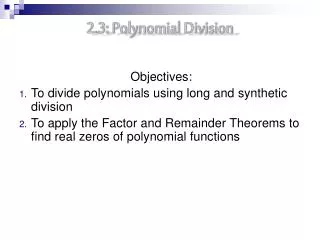
Dive into the process of polynomial division, specifically long and synthetic division, with comprehensive examples and clear explanations. Learn how to use the division algorithm to determine quotients and remainders, apply the Remainder Theorem for evaluating polynomials, and utilize the Factor Theorem for polynomial factoring. This guide includes step-by-step solutions to help you master polynomial division concepts and problem-solving techniques. Whether you're a student or a math enthusiast, enhance your understanding of polynomial operations.

Understanding Polynomial Division and Synthetic Division Techniques
E N D
Presentation Transcript
A. 2x3y – 3x5y2 B. 1 + 2x3y – 3x5y2 C. 6x4y2 + 9x7y3 – 6x9y4 D. 1 + 2x7y3 – 3x9y4
Division Algorithm • f(x) = d(x) * q(x) + r(x) • Dividend=divisor*quotient+remainder • If r(x) = 0, the d(x) divides evenly into f(x)
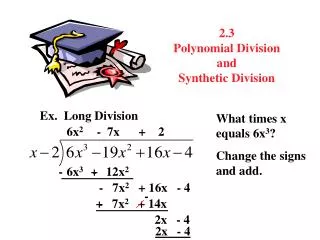
x(x – 5) = x2 – 5x –2x – (5x) = 3x 3(x – 5) = 3x – 15 Division Algorithm Use long division to find (x2 – 2x – 15) ÷ (x – 5). Answer: The quotient is x + 3. The remainder is 0.
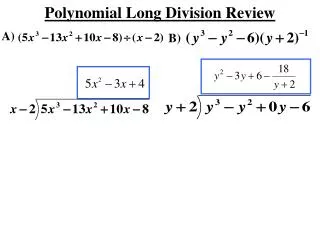
Polynomial Division Divide by x – 2
Aa + 3 B C D Quotient with Remainder Which expression is equal to (a2 – 5a + 3)(2 – a)–1?
Examples by
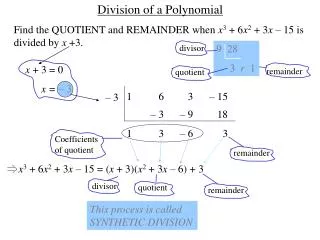
1 – 4 6 – 4 1 Synthetic Division Use synthetic division to find (x3 – 4x2 + 6x – 4) ÷ (x – 2). Step 1Write the terms of the dividend so that the degrees of the terms are in descending order. Then write just the coefficients as shown. x3 – 4x2 + 6x – 4 1 – 4 6 – 4 Step 2Write the constant r of the divisor x – r to the left. In this case, r = 2. Bring the first coefficient, 1, down as shown.
1 –4 6 – 4 2 1 –2 1 –4 6 – 4 2 –4 2 1 –2 Synthetic Division Step 3 Multiply the first coefficient by r : 1 ● 2 = 2. Write the product under the second coefficient. Then add the product and the second coefficient. Step 4Multiply the sum, –2, by r : 2(–2) = –4. Write the product under the next coefficient and add: 6 + (–4) = 2.
1 –4 6 – 4 4 2 –4 1 2 0 –2 Synthetic Division Step 5 Multiply the sum, 2, by r : 2(2) = 4. Write the product under the next coefficient and add: –4 + 4 = 0. The remainder is 0. The numbers along the bottom are the coefficients of the quotient. Start with the power of x that is one less than the degree of the dividend. Answer: The quotient is x2 – 2x + 2.
Example Use synthetic division to find (x2 + 8x + 7) ÷ (x + 1).
Divide by x + 3
Now it’s your turn! Divide
Divide numerator and denominator by 2. Simplify the numerator and denominator. Divisor with First Coefficient Other than 1 Use synthetic division to find (4y4 – 5y2 + 2y + 4) ÷ (2y – 1). Use division to rewrite the divisor so it has a first coefficient of 1.
Remainder Theorem • If a polynomial f(x) is divided by x – k, then the remainder is r = f(k) Find the remainder of divided by x + 2
Factor Theorem • A polynomial f(x) has a factor (x – k) if and only if f(k) = 0. Completely Factor if (x + 4) is a factor.
Example • Completely Factor