Understanding Periodic Table Trends: Key Comparisons of Elements
Discover essential trends in the periodic table that affect elements' behaviors. Learn how the attraction of valence electrons to the nucleus varies across periods and families. Explore key trends such as atomic radius, metallic and non-metallic reactivity, ionization energy, and electronegativity. Understand how the number of valence electrons and electron orbitals influence these properties, leading to significant differences among elements. This guide provides a coherent review of the periodic table's patterns, providing insights for students and chemistry enthusiasts alike.

Understanding Periodic Table Trends: Key Comparisons of Elements
E N D
Presentation Transcript
Tips when comparing elements • When you are looking at different elements in the same period, the difference between them has to do with the attraction of valence electrons to the nucleus • When you are looking at different elements in the same family/group, the difference between them has to do with the number of orbitals
Key Trends-Valence Electrons • The greater number of valence electrons, the stronger the attraction between the electrons and the nucleus • The lower the number of valence electrons, the weaker the attraction between the electrons and the nucleus
Key Trends-Orbitals • The greater the number of orbitals, the weaker the attraction between it and the nucleus • The lower the number of orbitals, the stronger the attraction between it and the nucleus
Review • More valence electrons→ more attraction to nucleus • Less valence electrons → less attraction to the nucleus • More electron orbitals → less attraction to the nucleus • Less electron orbitals → more attraction to nucleus
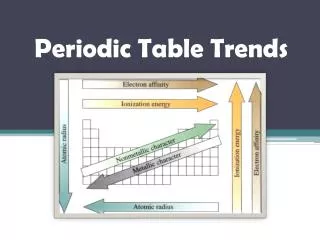
Periodic Table Trends • Patterns re-appear in the periodic table, from one period to the next! • Trends either go : • From high at the beginning of the period to low at the end of the period • From low at the beginning of the period to high at the end of the period • Four mains trends • Atomic Radius • Reactivity • Ionization • Electronegativity
Electronegtivity Electronegtivity
Atomic Radius • Definition: Distance between the nucleus and the outermost energy level • As one goes from the left of the table to the right, the net positive charge from the nucleus increases • More protons are in the nucleus • The radius therefore is biggest on the left and smallest on the right • This leads to electrons being attracted more to the nucleus, and reducing the radius • As one goes down a period, the atomic radius increases with the addition of more electron shells
Smallest Radius Biggest Radius
Metallic Reactivity • Metallic reactivity decreases as go left to right • More valence electrons lead to greater attraction to nucleus, reducing metallic reactivity • Metallic reactivity increases as go down the periods • Metals donate electrons to gain full octet, therefore the further the valence shell is from the nucleus, the easier it looses its electrons
Least Metallic Character Most Metallic Character
Non-Metallic Reactivity • Non-Metallic reactivity increases as go left to right • More valence electrons lead to greater attraction to nucleus, increasing non-metallic reactivity • The will to fill complete shell by adding electrons is greater • Metallic reactivity decreases as go down the periods • Less orbitals you have, closer the electrons are to the nucleus, creating the stronger pull to accept missing electrons to complete orbital
Most Non-Metallic Character Least Non-Metallic Character
Ionization energy • Def: Energy required to remove an electron from an atom • I.E activity increases as go left to right • Greater net positive charge in nucleus creating a stronger pull, resulting in it being harder to separate • I.E. activity decreases as go down the periods • More orbitals, resulting in less attraction between valence electrons and nucleus, making it easier to separate
Highest ionization energy Lowest ionization energy
Electronegativity • Def: Energy with which an atom holds on to its electrons • Electroneg. increases as go left to right • Greater net positive charge in nucleus creating a stronger pull, resulting in smaller atom radius holding on to electrons more • Electroneg. decreases as go down the periods • More orbitals, resulting in less attraction between valence electrons and nucleus, resulting in less hold on electrons
Electronegtivity Highest electronegtivity Electronegtivity Lowest electronegtivity