Download
1 / 5
50 likes | 173 Vues
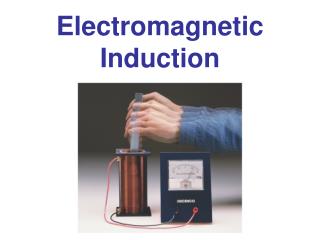
Learn the principles of induced electromotive force (EMF) through changing magnetic flux. This agenda explores Faraday’s Law for calculating induced EMF in circuits and Lenz’s Law to determine the direction of induced current. Delve into how generators operate using these laws, and the concept of back EMF. Additionally, discover motional EMF, including methods of producing it as conductors move through magnetic fields. Master the mathematical relationships and applications for real-world scenarios involving electromagnetic induction.

E N D
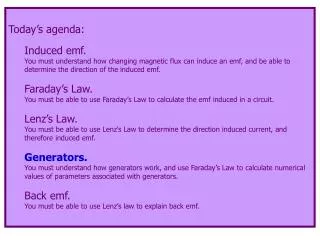
Today’s agenda: Induced emf. You must understand how changing magnetic flux can induce an emf, and be able to determine the direction of the induced emf. Faraday’s Law. You must be able to use Faraday’s Law to calculate the emf induced in a circuit. Lenz’s Law. You must be able to use Lenz’s Law to determine the direction induced current, and therefore induced emf. Generators. You must understand how generators work, and use Faraday’s Law to calculate numerical values of parameters associated with generators. Back emf. You must be able to use Lenz’s law to explain back emf.
Motional emf: an overview An emf is induced in a conductor moving in a magnetic field. Your text introduces four ways of producing motional emf. 1. Flux change through a conducting loop produces an emf:rotating loop. B start with this A side view derive these
2. Flux change through a conducting loop produces an emf: 2. Flux change through a conducting loop produces an emf:expanding loop. v B B start with these ℓ dA x=vdt derive these
3. Conductor moving in a magnetic field experiences an emf: 3. Conductor moving in a magnetic field experiences an emf: magnetic force on charged particles. start with these v B B – ℓ + derive this You could also solve this using Faraday’s Law by constructing a “virtual” circuit using “virtual” conductors.
4. Flux change through a conducting loop produces an emf:moving loop. start with this derive these