Objective- To solve projectile problems.
This resource focuses on solving projectile motion problems, including determining height over time, maximum height reached, and the time it takes for objects to hit the ground. Using real-life examples such as a rock thrown from a cliff and a baseball hit from an initial height, we derive the equations of motion, calculate maximum heights, and find intercept points. Key concepts covered include vertical speed, horizontal distance, and the effects of gravity on motion. Perfect for students and teachers in physics or mathematics.
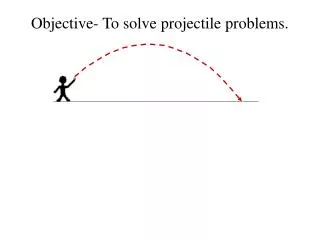

Objective- To solve projectile problems.
E N D
Presentation Transcript
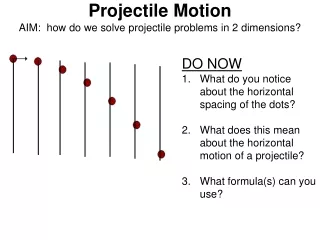
Objective- To solve projectile problems. Height Horizontal Distance
Objective- To solve projectile problems. Height Time
Objective- To solve projectile problems. Vertical Speed Time
Objective- To solve projectile problems. Horizontal Velocity Time
Objective- To solve projectile problems. Horizontal Distance Time
Height Time
Height Time A rock is thrown from a cliff with an initial height of 25 feet and an initial upward velocity of 100 ft/sec. Acceleration due to gravity is 16 ft/sec. Write an equation that describes its height, h, over time, t. 2
Height Time Find the max. height reached by the rock given . Vertex Axis
Height Time Find when the rock hits the ground given . (h=0) x-intercept
A baseball is hit with an initial height of 1 meter and an initial upward velocity of 32 m/s. Acceleration due to gravity is 4.9 m/s. 2 a) Write an equation to describe its height, h, over time, t.
b) Find the maximum height of the ball given . A baseball is hit with an initial height of 1 meter and an initial upward velocity of 32 m/s. Acceleration due to gravity is 4.9 m/s. 2 Vertex Axis
c) When will the ball hit the ground given ? A baseball is hit with an initial height of 1 meter and an initial upward velocity of 32 m/s. Acceleration due to gravity is 4.9 m/s. 2 (h=0) x-intercept