Module 1-Grade 9 (1)
module for grade 9

Module 1-Grade 9 (1)
E N D
Presentation Transcript
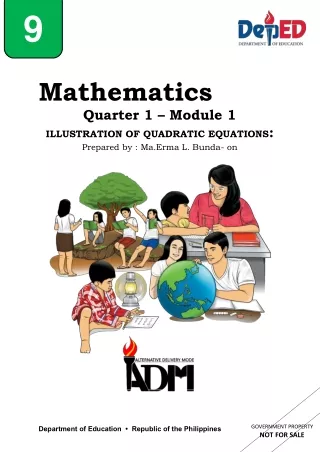
9 Mathematics Quarter 1 – Module 1 ILLUSTRATION OF QUADRATIC EQUATIONS: Prepared by : Ma.Erma L. Bunda- on GOVERNMENT PROPERTY NOT FOR SALE Department of Education • Republic of the Philippines
Mathematics Quarter 1 – Module 1: ILLUSTRATION OF QUADRATIC EQUATIONS reviewed by educators from public and private schools, colleges, and or/universities. We encourage teachers and other education stakeholders to email their feedback, comments, and recommendations to the Department of Education at action@deped.gov.ph. This instructional material was collaboratively developed and We value your feedback and recommendations.
Introductory Message For the facilitator: You have to let the learners understand that answering this module is very important. This will help them learn and master the required competencies for their grade level especially the lessons they missed in school due to some circumstances beyond control. Explain to them clearly the benefits they will gain in taking each part by heart. Your guidance and assistance will be helping them a lot. It is your role, too, to ensure that every learner will get the necessary help and support from their parents, elder siblings at home or even from other relatives, friends and neighbors. Moreover, you should not fail to remind them to handle this module with utmost care. This should remain neat and clean and free from unnecessary marks. They should use separate sheets in answering the different test parts and exercises. For the learner: This module can be your teacher and best friend. You will learn a lot from this because it was designed considering your needs. You have to study each part religiously. In doing such, you can seek the help of your teachers, parents, elder siblings or anybody whom you have the trust and confidence with. The module you will be working with is made up of the following parts and corresponding symbols: What I Need to Know This contains the skills or competencies you are about to learn in the specific lesson. What I Know This part is composed of a 10-item exercise serving as your pretest to assess what you already know. What’s In It is in this part where review questions or items be given to you. This will help you link the previous lesson with the current one. What’s New In this portion, the new lesson will be introduced to you in various ways: a story, a song, a poem, a problem opener, an activity or a situation. Department of Education • Republic of the Philippines
What is It go about the lesson. It also provides you the brief discussion of the topic or concept to develop. What’s More This comprises items for independent practice to further deepen your understanding of the topic. What I Have Learned This includes questions which will lead you to generalize or sum up your understanding of the topic presented. Steps on how a given process was undergone may also be included here. What I Can Do This part provides an activity which will help you transfer your knowledge into real-life situations or concerns. Assessment This is another 10-item test purposely to evaluate your level of mastery in achieving the learning competency. Additional Activities In this portion, another activity will be given to you to enrich your skill of the lesson learned. This will help you retain the concept in mind. Now that you are aware of the contents of this module, for sure you are ready to face the tasks and take the challenges along your journey. Always bear in mind that you are not alone. You have many companions who can assist you with whatever problem you will face. Don’t be afraid. Just reach them out in times you need them. This section gives you the step by step process of how you You have to answer the given exercises in this module on separate sheets of paper. After you are through, return it to your teacher who will be responsible of checking and determining your level of competency. \God bless you learner! Department of Education • Republic of the Philippines
What I Need to Know This module was designed and written with you in mind. It is here to help you master the skills in multiplying decimals. The scope of this module allows you to use it in many different learning situations. The language used recognizes your diverse vocabulary level. The lessons are arranged to follow the standard sequence of your course. But the order in which you read them can be changed to match with the textbook you are now using. In the study of Mathematics our knowledge and understanding about the manipulation of equations is very important. Solving problem with every little effort is a challenge. Quadratic Equations have many applications in our real life situation. In this module we will take the challenge in solving problems and manipulating equations by analyzing the problem well come up with the correct equations. After going through this module , you are expected to: 1.Illustrate the Quadratic Equations Department of Education • Republic of the Philippines
What I Know MULTIPLE CHOICE: Choose the letter of the correct answer. 1. It is a polynomial equation of degree two that can be written in the form ??2+ bx + c = 0, where a, b and c are real numbers and a ≠ 0. A. Linear Equation C. Quadratic Equation B. Linear Inequality D. Quadratic Inequality 2. Which of the following is a quadratic equation? A. 2?2+ 4? − 1 C. ?2 + 5s – 4 = 0 B. 3? − 7 = 2 D. 2?2 − 7? ≥ 3 3. In the quadratic 3?2 + 7x – 4 = 0, which is the quadratic term? A. ?2 C. 3?2 B. 7? D. – 4 4. Which of the following is the standard form of quadratic equations? A. ??2+ ?? + ? < 0,? ≠ 0 C. ?? + ?? + ? = 0 B. ??2+ ?? + ? = 0 ,? ≠ 0 D. ? = ?? + ? 5. What is the value of a in the given quadratic equation 2?2 − 7? + 10 = 0? A. -7 C. 2 B. 10 D. -10 6. Which of the following illustrate a quadratic equation? A. ?2− 2? + 5 = 0 C. x = y B. ? = 2? D. x + y = 0
7. What is the standard form of quadratic equation 4? + 5?2= 16 ? A. 5?2 = 4? − 16 C. 16 = 4? + 5?2 B. 5?2+ 4? − 16 = 0 D. - 5?+ 4? + 16 = 0 8. What is the quadratic term in the equation − 2?2 = 7? − 8 ? A. −2?2 C. 7x B. − 7? D. – 8 9. What is the value of b in the given equation ?2− 3? + 7 = 0 ? A. 7 C. – 3 B. 1 D. 3 10. What is c in the given equation ?2 − 7? + 12 = 0 ? A. 1 C. -7 B. 12 D. -12
Lesson 1 ILLUSTRATION OF QUADRATIC EQUATIONS WHAT’S IN A “ SQUARED” WORLD OF SECOND DEGREE EQUATIONS ? The definition of a second degree of quadratic equation is distinct from that of a Linear Equation. These are, however equations which are not in the second degree form but can be reduced into quadratic form. What’s In Do you remember these products? EXAMPLE : 3 ( ?2+ 7 ) SOLUTION : 3 ( ?2 + 7 ) = 3 ( ?2 ) + 3 ( 7 ) = 3?2 + 21 1. 2s ( s – 4 ) 2. ( w + 7 ) ( w + 3 ) 3. ( x + 9 ) ( x – 2 ) 4. ( x + 4 ) ( x + 4 ) 5. 6x ( x + 3)
What ‘s New An equation that can be written in the form ??2 + bx + c = 0 where a, b and c are real numbers with a ≠ 0 , is a quadratic equation in standard form. The name quadratic comes from the word “ QUAD” meaning square. If the quadratic equation in the following manner ??2+ ?? + ? = 0 in which all the nonzero terms on the left side equating to 0, it is said to be a quadratic equation in standard form. A quadratic equation is called degree equation because the left side is a polynomial of degree 2.
What is It Here are some of the examples below It is a quadratic equation in which a = 2, b = 5 and c = 3 2?2 + 5x + 3 = 0 You don’t usually write “1x” thus a = 1, b = -3 and c is not ?2- 3x = 0 shown because c = 0. 5x – 3 = 0 The term of degree 2 is missing which means a = 0, By the definition this equation can never be called quadratic. It is linear equation. Sometimes a quadratic equation does not always looks like the above examples. Observe the following quadratic equations: EQUATIONS IN QUADRATIC FORM STANDARD FORM a, b and c Move all terms to the left a = 1, b = -3 \?2 = 3x - 1 ?2 - 3x + 1 = 0 side of the equation. and c = 1 Expand ( eliminate the a= 2, b = -4 2( ?2 - 2w ) = 5 2?2– 4w – 5 = 0 brackets ) and move 5 to and c= - 5 the left side of the equation.
Expand and move 3 to the z ( ?1- v ) = 3 left side of the equation a= 1,b=1,c= -3 ?2 - z – 3 = 0 Multiply each side of the 5 + 1 ? - 1 ?2 = 0 a = 5,b=1,c= -1 equation by ?2. 5?2 + x – 1 = 0 I Illustrative examples: 1. ?2+ 7? − 8 = 0 Solution: ?2 + 7? − 8 = 0 → It is already in standard form , where a = 1, b = 7 and c = -8 2. 4?2− 3? = 5 Solution: 4?2− 3? = 5 4?2− 3? − 5 = 5 − 5 → Add – 5 to both sides 4?2− 3? − 5 = 0 → The equation in standard form. Thus , a = 4, b = -3 , c = - 5 3. 9?2 - 16 = 0 → It is already in standard form. Thus , a= 9, b = 0 , c = - 16 4. 4?2= 1 5 ? Solution: 4?2= 1 5 x 5 [ 4?2= 1 5 ? ] 5→ Multiply both sides of the equation by 5 to get rid of the Denominator. ( MPE). 20?2= ? → Write the equation in standard form by adding - x to both sides of the Equation. ( APE ). 20?2− ? = 0→The quadratic equation in standard fo9rm where a = 20, b = -1 c = 0
What’s More Write each of these equations in standard form and identify the real numbers a, b, and c Example: ?2 + 7m – 8 = 0 Solution: ?2 + 7m – 8 = 0 is already in standard form ,where a=1,b=7, c= -8 1. 4?2− 3? = 5 2. ?2− 16 = 8x 3. −3?2 + 5x = 7 4. ?2 - 5x + 10 = 0 5. 2?2 - 7t = 12
What I Have Learned An equation of the type ??2+ ?? + ? = 0 ,where a, b and c are constants and a ≠ 0 , is called the standard form of quadratic equation. Take note that : ??2→ is called the quadratic term or squared term bx →is called the linear term. c →i is called the constant term. a → the numerical coefficient of the quadratic term ( i.e., the number just in front of ?2.) b → the numerical coefficient of the linear term ( i.e., the number just in front of x )
What I Can Do A. Tell whether the following is a Quadratic Equation or Not Quadratic Equation. 1. C = πd 2. ?2 − 2? + 5 3. C 2= 2πr 4. ?2− 3 = 0 5. ( ? − 2 )2 - 5 = 0 6. 3?− 2 = 0 7. ?2− 2? = 5 8. 5?2+ 20? + 20 = 0 9. 4?2 = 25 10. ?2 + y – 6 = 0 B. Write the following quadratic equations in standard form 1. ?2 + 8? = 9 2. ? − 6 = −?2 3. ?2= 40 − 18? 4. 2?2 + ? = −11? 5. ? ( ? − 7 ) = 44
Assessment MULTIPLE CHOICE; Choose the letter of the correct answer. 1. Which of the following is a quadratic equation? a. C = 2πr c. x + 3x = 0 b. ?2 - 2x + 1 = 0 d. 3?3 - 4x = 0 2. What is the standard form of a quadratic equation 2?2− 7? = 12 ? a. 12 – 7t + 2?2 c. 2?2− 7? − 12 = 0 b. -7t + 2?2 = 12 d. 12 + 7t = 2?2 3. Which of the following is the quadratic term in the equation 2?2 - 3r – 5 = 0? a. -5 c. -3r b. 2?2 d. 0 4. What is the value of c in the equation ?2+ 8? + 15 = 0? a. 8 c. 1 b. 15 d. -15 5. It is a polynomial equation of degree two that can be written in the form ??2+ ?? + ? = 0 , where a, b, and c are real numbers and a ≠ 0. a. Quadratic Inequality c. Linear Inequality b. Quadratic Equation d. Linear Equation 6. What is the standard form of quadratic equation ?2+ 5? = 24? a. 5? + ?2 = 24 c. 24 = ?2 + 5? b. ?2+ 5? − 24 = 0 d. ?2+ 5? + 24 = 0
7. What is the value of b in the equation ?2− 3? + 4 = 0? a. 1 c. 3 b. – 3 d. 4 8. Which of the following illustrate a quadratic equation in standard form? a. ?2− ? − 6 = 0 c. − ?2− 2 = ? b. ?2− 3? = 10 d. − 2? 2= 7? − 8 9. Which of the following is the standard form of quadratic equations? a. ??2+ ?? + ? = 0 ,? ≠ 0 c. ?? + ?? + ? = 0 b. ? = ?? + ? d. ??2+ ?? + ? < 0,? ≠ 0 10. What is the value of a in the quadratic equation 5?2+ 9? − 10 = 0? a. 9 c. – 10 b. – 5 d. 5
Additional Activities Complete the following table. c QUADRATIC EQUATION STANDARD FORM a b 1. ?? + ?? = ??? 2. ??? - 20 = 6x 3. ??= ?? 4. ?? − ???= ?? 5. ?? − ??? = ? a.
Answer Key WHAT I KNOW WHAT’S INWHAT’S MORE 1.C 1. ??? –?? 1. ???− ?? − ? = ? 2.C 2. ??+ ??? + ?? a = 4, b = - 3 , c = - 5 3.C 3. ??+ ?? − ?? 2. ?? - 8x – 16 = 0 4.B 4. ??+ ?? + ?? a = 1 , b = - 8 , c = - 16 5.C 5. ???+ ??? 3. –??? + ?? − ? = ? 6.A 4. ??− ?? + ?? = ? 7.B a = 1, b = -5 ,c = 10 8.A 5. ???− ?? − ?? = ? 9.C a = 2 , b = - 7 , c = - 12 10.B WHAT CAN I DO ASSESSMENT A.1. b 1.Not quadratic equation 2. c 2.Quadratic Equation 3. b 3.Not Quadratic Equation 5. b 4.Quadratic Equation 6. b 5.Quadratic Equation 7. b 6.Not Quadratic Equation 8. a 7.Quadratic Equation 9. a 8.Quadratic Equation 10. d 9.Quadratic Equation 10.Quadratic Equation ADDITIONAL ACTIVITIES B. 4. b 1. ?2+ 8? − 9 = 0 1. − 9?2 + 9? + 28 = 0 2. ?2+ ? − 6 = 0 a = - 9, b = 9, c = 28 3. ?2 + 18x – 40 = 0 2. 7?2− 6? − 20 = 0 4. 2?2+ 11? + 12 = 0 a= 7, b = - 6 , c = - 20 5. ?2− 7? − 44 = 0 3. ?2 − 3? = 0 a = 1, b = - 3, c = 0 4. − 2?2− 3? + 15 = 0 a = - 2, b = - 3, c = 15 5. −4?2 + 3? − 8 = 0 a = - 4, b = 3, c = - 8
References: Learner’s Materials for Mathematics Grade9 Intermediate Algebra Authors : Soledad Jose -Dilao, Ed.D. Julieta G. Bernabe Understanding Mathematics Grade 9 Authors: Frelie B. Tan – Faylogna Lanilyn Lasic – Calamiong