Recursion Prog
This guide provides various examples of recursive functions in C programming, including addition of two numbers, calculation of powers, summation of even numbers, reversing strings and numbers, generation of the Fibonacci series, and printing patterns. Each function is detailed with its logic and implementation, showcasing the power and utility of recursion in solving complex problems in a concise manner. This resource is suitable for both beginners and experienced programmers looking to enhance their skills in recursion.

Recursion Prog
E N D
Presentation Transcript
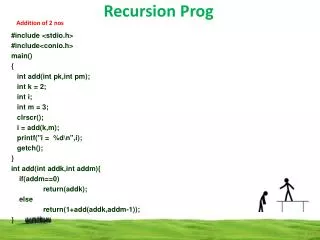
Addition of 2 nos #include <stdio.h> #include<conio.h> main() { int add(int pk,int pm); int k = 2; int i; int m = 3; clrscr(); i = add(k,m); printf("i = %d\n",i); getch(); } int add(int addk,int addm){ if(addm==0) return(addk); else return(1+add(addk,addm-1)); } Recursion Prog
Power function #include<conio.h> #include <stdio.h> int main() { double power(double x, int n); double x = 0.0; int n = 0; clrscr(); printf("%lf",power(3,2)); getch(); } double power(double x, int n) { if(n == 0) return 1.0; else return x * power( x , n - 1 ); } Recursion Prog
Even sum #include<conio.h> #include <stdio.h> void main() { int sum(int,int ); int total; total=sum(2,4); clrscr(); printf("%d",total); getch(); } int sum(inti,int n){ static int even=0; if(i<=n){ even=even+i; sum(i+2,n); //calling same function } return even; } Recursion Prog
Reverse String #include<string.h> void reverse(char [],int b); void main() { char a[26]; intlen; clrscr(); printf("enter string "); Scanf(“%s”,a); len=strlen(a); reverse(a,len); getch(); } void reverse(char a[],int len) { if(len==0) printf("%c",a[len]); else { printf("%c",a[len]); reverse(a,len-1); } } Recursion Prog
Reverse Number #include<conio.h> #include <stdio.h> int sum=0,r; void main() { int reverse(int); intnum,rev; clrscr(); printf("\nEnter a number :"); scanf("%d",&num); rev=reverse(num); printf("\nAfter reverse the no is :%d",rev); getch(); } Int reverse(int num) { if(num>0) { r=num%10; sum=sum*10+r; reverse(num/10); } else{ return sum; } return sum; } Recursion Prog
Fibnocci Series void main() { long term(int); inti,n; clrscr(); printf(“Enter Limit”); scanf("%d",&n); printf("\nThe Series is :”); for(i=1;i<=n;i++) { printf(" %ld ",term(i)); } getch(); } long term(int n) { if(n==1) return(0); else if(n==2||n==3) return 1; else return(term(n-1)+term(n-2)); return 0; } Recursion Prog
Print Pattern main() { int i,n; void pat(int); clrscr(); for(i=1;i<=10;i++) { pat(i); } getch(); } void pat(int n) { if(n<1) printf("\n"); else { printf("%d ",n); n=n-1; mult(n); } } Recursion Prog
Print Nos in Descending ordre main() { int i,n; void de(int); clrscr(); de(20); getch(); } void de(int n) { if(n==0) return(0); else { printf("\n %d",n); de(n-1); } } Recursion Prog
Print EVEN Nos in Descending ordre main() { int i,n; void de(int); clrscr(); de(20); getch(); } void de(int n) { if(n==0) return(0); else { printf("\n %d",n); de(n-2); } } Recursion Prog