Download
1 / 12
140 likes | 306 Vues
Hydraulic systems are vital in machine operation, utilizing incompressible liquids to transmit force efficiently. This overview covers the basic principles of hydraulics, including the properties of liquids, the mechanics of force multiplication, and the distinctions between open-center and closed-center systems. We discuss the advantages of simplicity, adaptability, and compact design, alongside disadvantages like efficiency concerns. Also explored are various hydraulic configurations and the transformation of energy within these systems, providing a foundational understanding for those interested in hydraulics.

E N D
Hydraulic Systems The Basics
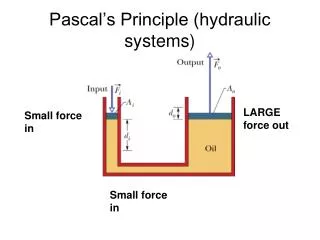
Basic Principles • Liquids: • Have no Shape • Are incompressible • Transmit force in all Directions, Equally • Multiply Force F P A
Advantages: Flexibility Multiplication of Force Simplicity Compact Economy Safety Disadvantages: Efficiency Cleanliness Advantages & Disadvantages of Hydraulics
Primary Hydraulic Systems • Open-Center Systems: • Oil is pumped constantly, excess oil is returned to the reservoir. • Closed-Center Systems: • Oil is pumped on demand, control valve stops oil flow.
Open-Center Systems • Simplistic • Inexpensive • Ineffective with Multiple Applications • Variations of Open-Center Systems: • Open-Center with a Series Connection • Open-Center with a Series Parallel Connection • Open-Center with a Flow Divider
Closed-Center Systems • No Relief Valves Needed • Application can be tailored by restricting flow • Specialized functions have more support • Multiple functions can be used at the same time • Variations of Closed-Center Systems: • Closed-Center with Fixed Displacement Pump and Accumulator • Closed-Center with Variable Displacement Pump
Hydraulic Facts • Mechanical-Hydraulic-Mechanical • Inputs and Outputs • Three types of Hydraulic Energy: • Potential, Kinetic, & Heat • None are created or destroyed, only converted • All energy input is converted into an output, gain (work) or loss (heat) • A restricted flowing liquid creates heat • This also causes a pressure drop • Hydraulic systems must be sealed to work
Hydraulic Facts • Oil takes the path of least resistance • Oil is pushed into a pump, not drawn • A pump does not create pressure, it creates flow. Pressure is caused by resistance to flow. • These can produce the same power: • High pressure & low flow • Low pressure & high flow • Two basic types of hydraulics: • Hydrodynamics • Hydrostatics