Understanding Nested Loops and Two-Dimensional Arrays in Java Programming
This chapter provides a comprehensive overview of nested loops and two-dimensional arrays in Java. You'll learn how nested loops are utilized for processing two-dimensional arrays, including examples of inner loops and dependent loops. The concept of two-dimensional arrays will be introduced with practical examples, demonstrating how to represent grids of information and use them in applications such as computer graphics. Additionally, we will cover the initialization, population, and manipulation of two-dimensional arrays, essential for effective programming in Java.

Understanding Nested Loops and Two-Dimensional Arrays in Java Programming
E N D
Presentation Transcript
Chapter 9Nested Loops and Two-Dimensional Arrays Lecture Slides to Accompany An Introduction to Computer Science Using Java (2nd Edition) by S.N. Kamin, D. Mickunas, E. Reingold
Chapter Preview In this chapter we will: • show how nested loops are useful • introduce two-dimensional arrays • describe the use of two-dimensional arrays to represent grids of information • show how computer graphics are generated using pixels
Nested for Loops • Nested loops frequently used to process two-dimensional arrays • Often body of inner loop is where the main computation is done • Example: for (i = 0; i < m; I++) { before inner loop for (j = 0; j < n; j++) body of inner loop after inner loop };
Dependent for Loops • Sometimes the extent of the inner nested loop will depend on the index value of the outer loop • Example: for (i = 0; i < 3; i++) { out.print(“i= “; + i + “: j = “); for (j = 0; j <= i; j++) { out.print(“ “ + j); } }
Nested Loop Contained in Other Statements for (int i = 1; i <= 10; i++) { if (i % 2 == 0) // i even for (int j = 1; j <= i/2; j++) out.print(“*”); else // i odd for (int k = 1; k <= 5 – i/2; k++) out.print(“#”); out.println(); }
Output ##### * #### ** ### *** ## **** # *****
Two-Dimensional Arrays • Declaration similar to one dimensional arrays • Need to specify both the number of rows and columns during allocation • Example: final int COLS = 6, ROWS = 5; double[][] energyTable = new double[ROWS][COLS]
Computing Row Totals double [] yearTotals = new double[ROWS]; for (y = 0; y < ROWS; y++) { // compute total for year y yearTotals[y] = 0.0; for (s =0; s < COLS; s++) yearTotals[y] = yearTotals[y] + energyTotal[y][s]; }
Populating energyTable int y, s; // reads 30 numbers needed to fill // energyTable one row at a time for (y = 0; y < ROWS; y++) for (s = 0; s < COLS; s++) energyTable[y][s] = in.readDouble();
Initializing Two-Dimensional Arrays double[][] energyTable = { {18.9, 19.4, 34.2, 3.9, 5.7, 0.3}, {19.1, 19.3, 33.6, 3.0, 6.2, 0.2}, {18.8, 19.6, 32.9, 3.1, 6.6, 0.2}, {18.9, 20.3, 33.5, 2.8, 6.7, 0.2}, {19.6, 20.8, 33.8, 3.1, 6.5, 0.2} };
Arrays of Arrays When we write energyTable = new double[ROWS][COLS]; This is shorthand for energyTable = new double[ROWS][]; for (int i = 0; i < ROWS; i++) energyTable[I] = new double[COLS];
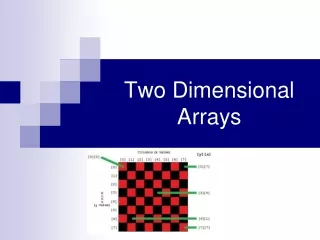
Computer Graphics • Computer graphics is the study of methods of representing and manipulating images • A two-dimensional array can be used to represent the image to be displayed • This array is called a frame buffer ; it has one entry for each pixel giving its color • The number of pixels in the frame buffer is the resolution the display device
Bresenham’s Line Drawing Algorithm • Draw (x0, y0) and compute p0 = 2y - x • Repeat for values of i from 1 to x – 1 : • Calculate xi+1 = xi + 1 • Calculate yi+1 = yi + 1, if pi > 0 yi , otherwise • Draw a pixel at (xi+1, yi+1) • Compute pi = pi + 2y - 2x(yi+1 - yi)
Two-Dimensional Arrays and length • A.length is number of rows in two-dimensional array A • A[i].length is number of columns in row i from two-dimensional array A • In Java rows can be of different lengths • Example: int[][] A = new int[5][]; for (int i = 0; i < 5; i++) { A[i] = new int[i + 1]; }