Magnetic Fields Produced by Currents
80 likes | 211 Vues
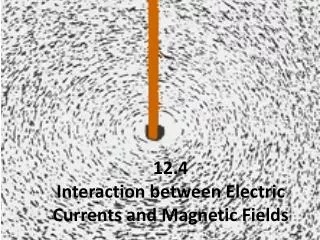
This guide explores how moving charges or electric currents generate magnetic fields. Key concepts include the right-hand rule for currents (RHR-2), which helps visualize the direction of the magnetic field relative to the current. It also delves into the interactions between parallel wires carrying currents in opposite and same directions, using the right-hand rule for forces (RHR-1). We highlight the importance of loops of wire in magnetic field generation and introduce the solenoid as a special case of multiple current loops.


Magnetic Fields Produced by Currents
E N D
Presentation Transcript
Magnetic Fields Produced by Currents February 14, 2007
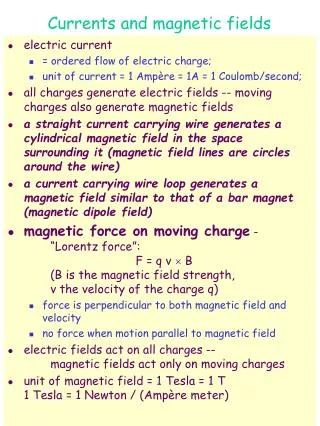
I r B Long, straight wire Moving Charges Produce Magnetic Fields • “moving charges” = “current” Right hand rule for currents (RHR-2): Thumb in direction of current, fingers curl in direction of B-field.
RHR-1: Fingers along B Thumb along v Palm shows F I2 L I1 (eqn 21.3 in book) Example: Two Wires (opposite directions) r
RHR-1: Fingers along B Thumb along v Palm shows F I2 L I1 (eqn 21.3 in book) Example: Two Wires (same direction) r
Current I Loop of Wire (N=1 turn) RHR-2 Thumb along current I Fingers curl along B B Loop with N Turns:
Adding Loops of Wire (same radius) Loop with N Turns X 1 X 2 X 3 X 4
The Solenoid L B I I Similar (but not exactly the same) to adding N turns of wire with equal radius: But let’s just call B-field through solenoid