Advancements in VOC Analysis Using PTR Technique for ASCOS Contributions
This presentation highlights the integration of the Proton Transfer Reaction (PTR) technique in analyzing Volatile Organic Compounds (VOCs) for the ASCOS project. Key methods such as PTR-MS and HR-PTR-TOFMS showcase their strengths in sensitivity, low limits of detection, and broad detection capabilities for various hydrocarbons, terpenes, and aerosol precursors. Continuous measurements, aerosol collection, and thermal desorption analysis are pivotal in characterizing air masses and studying VOCs in various environments, including marine settings. Insights from previous data enhance our understanding of VOC dynamics.

Advancements in VOC Analysis Using PTR Technique for ASCOS Contributions
E N D
Presentation Transcript
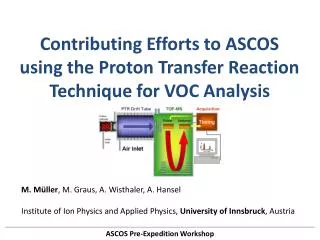
Contributing Efforts to ASCOS using the Proton Transfer Reaction Technique for VOC Analysis M. Müller, M. Graus, A. Wisthaler, A. Hansel Institute of Ion Physics and Applied Physics, University of Innsbruck, Austria ASCOS Pre-Expedition Workshop
PTR-MS: Reaction: H3O+ + VOC → VOCH+ + H2O Proton transfer reaction when PA(VOC)>PA(H2O) H3O+ H3O+ H3O+ H3O+ H2O+ O+ H+ OH+ H3O+ H3O+ VOC•H+ e– H3O+ H2O VOC ASCOS Pre-Expedition Workshop
What do we detect: • Most hydro carbons and derivates • Terpenes • Aromatics • Photo oxidation products and other oxyVOCs • Ketones • Aldehydes • Alcohols • Aerosol precursors • DMS and oxidation products (DMSO) • High molecular species (semi volatile) ASCOS Pre-Expedition Workshop
Performance Summary PTR-MS: • Advantages: • Compact organic trace gas analyser • Mostly non dissociative ionization • Excellent sensitivity • Low limit of detection ~10 pptv • Disadvantage: • Poor selectivity ASCOS Pre-Expedition Workshop
PTR Drift Tube TOF-MS Pulser Detector Signal Sample Inlet Time of Flight HR PTR-TOFMS: M. Graus, M. Müller, A. Wisthaler, A. Hansel Acquisition Timing ASCOS Pre-Expedition Workshop
Performance Summary HR PTR-TOFMS: • Detects all ions in one instant • Separation of isobars is possible • Identification of the elemental composition • High sensitivity • Low pptv range LOD m/z=79.022 m/z=79.055 ASCOS Pre-Expedition Workshop
Planed Innsbruck’s contributions to ASCOS: VOC air mass characterization Continuous measurements Aerosol collection (5 stage BCI) and analysis for organic compounds Heli profiles of VOCs Off-line thermal desorption analysis 6-8 SilcoCanoff-line sampling technique • HLC-Setup • Molekular mass • HLC for identification • quantitativ • Analysis of solved VOCs in sea water: • Surface µ-layer samples • Surface layer samples
Why off-line heli profiles using 6-8 SilcoCans? Lets look at some AOE 2001 data! EGU General Assembly 2008
AOE Results by Armin Wisthaler: Expected SilcoCan Data EGU General Assembly 2008
AOE Results by Armin Wisthaler: Expected SilcoCan Data Very low DMS concentration => high signal/noise • High precision data • low signal/noise • Whole mass scans possible • Isobaric identification possible (TOF) EGU General Assembly 2008
THANK YOU EGU General Assembly 2008