Download
1 / 18
180 likes | 291 Vues
The Self-Strengthening Movement emerged in late 19th-century China as officials sought to modernize military capabilities through industrialization and Western technologies. Key figures like Zeng Guofan and Li Hongzhang led efforts to manufacture weapons and establish the first modern enterprises. However, the movement faced challenges, including opposition from conservative factions and the consequences of foreign imperialism, highlighted by the Treaty Ports and low tariffs. A growing social class sought modernization amidst rising public dissent, leading to political movements and reform attempts such as the 100 Days' Reforms.

E N D
The Self-Strengthening Movement • Aim was military strength • Manufacture weapons • Officials set up the first modern industrial enterprises
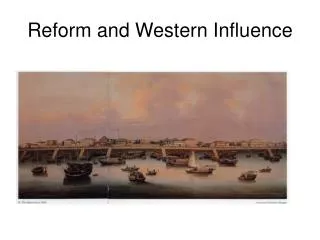
The Treaty Ports • Reasons for their growth • Low tariffs • Extraterritoriality • British commercial law
A class at French school that took mainly Russian refugee children
The growth of a social class with an interest in modernisation • Government employees • Yan Fu • Overseas Chinese
Merchants who work with foreign traders (compradores) • Tang Jingxing • Sir Boshan Wei Yuk (compradore of forerunner of HSBC Bank) • Feel excluded from the government
Rise of oppositional public opinion • Newspapers • Writers • Political parties
The Qing dynasty’s problems in the 1890s • Dependence on the treaty system • Decentralisation • The rise of regional governors • Zeng Guofan • Li Hongzhang • Foreign imperialism • Vietnam 1884 • Korea 1895 • Taiwan 1895
The 100 Days Reforms of 1898 • Kang Youwei petitions the young Guangxu emperor • Abolition of the “eight-legged” essay • Stimulate agriculture, industry and commerce • Western-style drills in the army • Coup by Dowager Empress Cixi • Kang creates China’s first political party • The Protect the Emperor Society