Understanding Noun-Adjective Agreement in English and Spanish
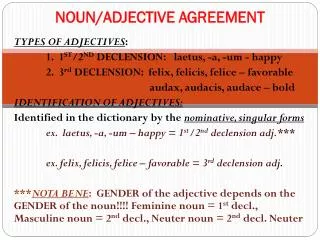
This guide explores the rules of noun-adjective agreement in both English and Spanish. In English, adjectives typically precede nouns, while in Spanish, they generally follow the nouns and must agree in gender and number. This involves matching masculine and feminine forms, as well as singular and plural distinctions. The guide provides clear examples for each case, helping learners understand how to apply these rules effectively for accurate sentence structure in both languages.


Understanding Noun-Adjective Agreement in English and Spanish
E N D
Presentation Transcript
Noun-Adjective Agreement Nouns are ALL-POWERFUL!!!!!
*Example in English: *In English, adjectives usually come before nouns. • the serious student adjective noun
*Example in Spanish: *In Spanish, adjectives usually come after nouns. • el estudianteserio noun adjective
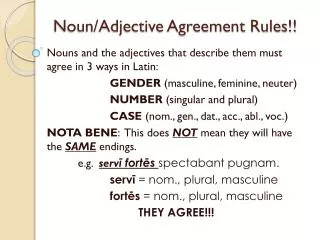
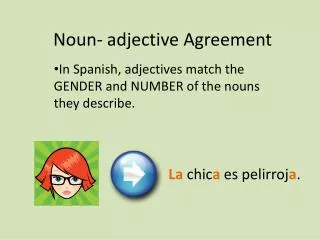
In Spanish, adjectives must match the GENDER and NUMBER of the nouns they describe.
*First, you must match the gender. *If the noun is masculine (usually ends in –o), the adjective must also bemasculine(usually ends in –o). *Example: el chico alto
*If the noun is feminine (usually ends in –a), the adjective must also befeminine (usually ends in –a). *Example: la chicaalta
*Next, you match the number. *If the noun is singular (only one of it), the adjective must also besingular. *Example: el chico alto *Example: la chicaalta
*If the noun is plural (more than one of it), the adjective must also beplural. *Example: los chicos altos *Example: laschicasaltas
*Make sure the article matches in gender and number too! *Example: loschicos altos *Example: laschicasaltas
*Adjectives that end in –e match both genders *Example: • el maestrointeligente/la maestrainteligente BUT don’t forget to match NUMBER! *Example: lasmaestrasinteligentes
*Adjectives that end in a consonant generally match both genders *Example: el amigojoven *Example: la amigajoven
*Some adjectives that end in a consonant add –a to form the feminine. These exceptions must be memorized. *Example: el chicotrabajador *Example: la chicatrabajadora
*To make a word plural, add –s if it ends in a vowel *Example: el chico = los chicos *Example: la estudiante= lasestudiantes
*To make a word plural, add –esif it ends in a consonant *Example: el estudiantetrabajador = los estudiantestrabajadores *Example: la mujerjoven = lasmujeresjóvenes