Download
1 / 19
200 likes | 321 Vues
The nervous system is a complex network made up of neurons, crucial for processing and transmitting information throughout the body. It consists of the Central Nervous System (CNS), including the brain and spinal cord, and the Peripheral Nervous System (PNS), which connects to all other body parts. The PNS contains sensory neurons that gather information and motor neurons that initiate responses. Additionally, the PNS is divided into autonomic (involuntary) and somatic (voluntary) systems. This overview also touches on electrical impulses, action potentials, and the impact of toxins on neural function.

E N D
Nervous System • Made up of nerve cells called neurons found in the: • Brain • Spinal Cord • All of the nerve cells connected to all other parts of the body
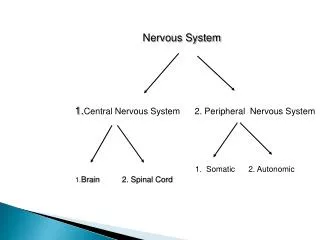
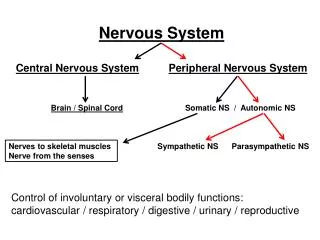
Nervous System • The nervous system can be divided into the: • Central Nervous System – brain and spinal cord • Peripheral Nervous System – neurons outside the spinal cord/brain
PNS • The PNS is made up of: • Sensory neurons (affector neurons) – detect changes in the external and internal environment and sends information to the CNS • Motor neurons (effector neurons) – send information away from the CNS to muscles and other effector organs
PNS • The motor neurons of the PNS can be further divided into 2 categories: • Autonomic nervous system – involuntary, transmits messages to internal organs • cannot be consciously controlled by thoughts • Somatic nervous system – voluntary, transmits messages to skeletal muscle • can be consciously controlled
CNS • The CNS acts as the control centre of the entire nervous system: • It processes the information received by the sensory neurons in the PNS; and • sends messages back through motor neurons in the PNS to the effector organs, initiating a response.
Summary Nervous system CNS PNS Sensory Motor Voluntary Involuntary Spinal Cord Brain Autonomic Somatic
Nerve cells, Neurons • These are the basic units of the nervous system • There are 3 main types: • Sensory (affector) • Motor (effector) • Interneurons (connecting neurons) • When many neurons are connected together in a bundle, they are called a nerve
Neurons • Neurons are able to pass messages onto other neurons and cells by sending electrical impulses called action potentials • Electrical impulses are created by a rapid change in positive/negative charges across the membrane of the neuron • Electrical impulses are generated when a stimulus is detected
Action Potentials • There are 4 main phases in an action potential: • Resting potential – when neuron is not active/stimulated - there is a difference in charge across membrane, called potential • More + outside membrane compared to inside
Action Potentials • Depolarisation – when the neuron is stimulated the potential reverses and this change in potential is carried along the axon to the axon terminal, causing a signalling molecule called a neurotransmitter (within the secretory vesicles) to be released • This neurotransmitter then diffuses across a very short distance (called a synapse) to the neighbouring (postsynaptic neuron, causing it to be stimulated
Action Potentials • Repolarisation – The potential returns to resting state • More + outside membrane compared to inside • Refractory period – For a brief period after repolarisation, the neuron cannot be stimulated again http://www.learner.org/channel/courses/biology/archive/animations/hires/a_neuro1_h.html
http://www.learner.org/channel/courses/biology/archive/animations/hires/a_neuro2_h.htmlhttp://www.learner.org/channel/courses/biology/archive/animations/hires/a_neuro2_h.html
Depolarisation – stimulus reached threshold Resting potential Repolarisation
K+ flows out of neuron Na+ comes into neuron
Animations • http://outreach.mcb.harvard.edu/animations/actionpotential.swf
Toxins and venom • Toxins and venoms produced by animals such as snakes and spiders can cause paralysis • This is because they can: • interfere with the release of neurotransmitters • Prevent transmission of electrical impulses from travelling along the axon • Damage the presynaptic or post-synaptic membranes