Reference Model for Evaluating Intelligent Tutoring Systems
This document presents a comprehensive overview of Intelligent Tutoring Systems (ITS) and the methodologies for evaluating their effectiveness. It emphasizes the goal of replicating a competent human tutor's adaptive teaching capabilities. The evaluation can be formative or summative, involving various techniques, including software engineering methods and empirical assessments. Key areas explored include learner models, cognitive strategies, user interaction, and the architecture's influence on educational outcomes. The report advocates for realistic evaluation processes to enhance ITS design and effectiveness.

Reference Model for Evaluating Intelligent Tutoring Systems
E N D
Presentation Transcript
Reference Model for Evaluating Intelligent Tutoring Systems Esma Aimeur, Claude Frasson Laboratoire HERON Informatique et recherche opérationnelle Université de Montréal
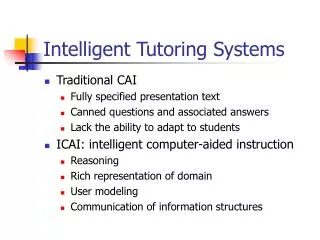
Introduction • Goal of an ITS (Intelligent Tutoring System): produce the behaviour of an intelligent (competent) human tutor who can adapt his teaching to the learning rythm of the learner • Ability to model and reason about domain knowledge, human thinking, learning processes, and teaching process • building an ITS needs also to evaluate the system • lack of evaluation methodology Laboratoire HERON - TICE 2000
Architecture of an ITS Student Laboratoire HERON - TICE 2000
Evaluation of ITS • Evaluation can be formative or summative • Summative: after the design process • Formative: during the design (define and refine goals and methods) • Evaluation techniques used in • ITS • Software engineering Laboratoire HERON - TICE 2000
Evaluation of some ITS • SHERLOCK : experimental evaluation • VCR Tutor : 4 versions compared • Formative qualitative evaluation • iterative design • formative methods • qualitative : characteristics of a situation • quantitative : finding causes and consequences • case studies Laboratoire HERON - TICE 2000
Lester’s evaluation • On animated pedagogical agents (Design a Plant) --- botanical and physiology • 100 middle school students • Important educational benefits : improved problem solving • Better than less expressive animated agents Laboratoire HERON - TICE 2000
Littman- Soloway • What is the educational impact on students ? • What is the relationship between the architecture of an ITS and its behavior ? • External evaluation of the student model (Proust) • Internal evaluation : architecture, how ITS respond to input values Laboratoire HERON - TICE 2000
Van Lehn • Teaching metacognitive skills to implement and evaluate an ITS (SE-Coach guide self-explanation) • Empirical evaluation • Fundamental questions • How the design tools are used efficiently ? • How the learner improve his knowledge ? Laboratoire HERON - TICE 2000
Software engineering techniques • Product : Boehm’model • software doing what the user want it to do • use resources correctly • easy to learn • well designed, code • easily tested and maintained Laboratoire HERON - TICE 2000
HCI techniques • Evaluating design • cognitive walthrough (how easy a system is to learn) • heuristic evaluation (visibility, consistency, flexibility, helps for the user) • model-based evaluation (GOMS) predict user performance Laboratoire HERON - TICE 2000
Evaluationg Implementation • Empirical and experimental methods • Observational methods (user completes a set of tasks) • Query techniques • interviews of the users about their experience • questionnaires : questions fixed in advance Laboratoire HERON - TICE 2000
Learner model • Layers : • cognitive • affective • inferential • Learning time : speed of knowledge acquisition • Tracability : of learner’s actions Laboratoire HERON - TICE 2000
Levels of knowledge Based on works of Gagné (1985) 7 levels of knowledge 4 principal levels Novice Beginner Intermediate Expert Learner model Laboratoire HERON - TICE 2000
Learning strategies • One-on-one • Co-learner • Learning Companion • Learning by Disturbing Laboratoire HERON - TICE 2000
Learning strategies • Diversity • Adaptability (switching to different strategies) • Modification • Memorization • Feedback • Reduce cognitive load Laboratoire HERON - TICE 2000
Curriculum • Generalisation • Consistency • Knowledge articulation • Reusability • Navigability • Maintenance Laboratoire HERON - TICE 2000
Interface • Intuitive : learner should understand easily the functions to apply • Interactivity : allowing the learner to be active in his learning environment • Matching : using words, phrase and concepts Laboratoire HERON - TICE 2000
General • Productivity rate : the most important factor. Time spent to produce one hour of ITS based course • Learning outcomes : performance obtained by the learner after the session • Ease of use of the tools Laboratoire HERON - TICE 2000
Conclusion • Evaluation process is complex but needs to be realistic • Develop first , evaluate later • Evaluation criteria as a guideline for estimation Laboratoire HERON - TICE 2000
Merci de votre attention Laboratoire HERON - TICE 2000
Stratégies d ’apprentissage Tuteur Co-apprenant Compagnon Apprentissage par explication Laboratoire HERON - TICE 2000