Download
1 / 25
250 likes | 336 Vues
Explore theoretical models of discovery science, informatics tools, and interdisciplinary collaboration. Meet domain experts, engage in practical activities, and analyze gaps for scientific practice advancement. Course expectations, themes, objectives, and assignments detailed.

E N D
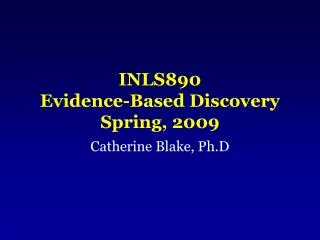
INLS890 Evidence-Based DiscoverySpring, 2009 Catherine Blake, Ph.D
Today • Introductions • Administration • Course Structure • Learning Objectives • Assessment • Motivation
Introductions • Dr Catherine Blake • Email - cablake@email.unc.edu • Office - 214A Manning Hall • Lecture Time • 214 Manning Hall • Thurs 5:00-7:30pm • Office Time • Email – anytime • By Appointment – Tues and Wed
Operational Details • Web Page • http://www.ils.unc.edu/~cablake/INLS890-EBD • Username = ebd Password = spr2009 • Email • Fastest response time • Please email from your UNC account • Start the subject with INLS890 • University Honor Code is in effect
Course Objectives • This course combines theoretical models from discovery science, with a survey of informatics tools that support discovery. • The seminar will show-case the discovery process via a lecture series comprising both discipline and policy champions and thus reveal the synergy between synthesis and discovery and the need for interdisciplinary collaboration.
Theory Theme • Kuhn • Normal versus Revolutionary Science • Abnormalities • Chalmers • Observation • Falsification • Information Quality • Meta-analysis • Information quality
Informatics Theme • Language tools • Information Extraction - Text Mining • Document Summarization - Entailment • Social Networking • Bibliometrics - Visualizations • Workflow • Myexperiment • Domain specific software • Chrystallography - BLAST
Practice Theme • Synthesis • Timothy S. Carey, MD, MPH Sarah Graham Kenan Professor of Medicine Director, Cecil G Sheps Center for Health Services Research • Ila Cote, PhD, DABT Acting Division Director US Environmental Protection Agency National Center for Environmental Assessment • Discovery • Paul Jones Clinical Associate Professor School of Information and Library Science Director of ibiblio.org • Michael T Crimmins PhD. Mary Ann Smith Distinguished Professor of Chemistry UNC and Department Chair Department of Chemistry • Rudy L Juliano PhD. Boshamer Distinguished Professor of Pharmacology Principal Investigator, Carolina Center of Cancer Nanotechnology Excellence
Practice Theme • Discovery • Robert C Millikan DVM PhD Barbara Sorenson Hulka Distinguished Professor Department of Epidemiology School of Public Health • Jan F. Prins PhD. Professor of Computer Science and Chairman, Department of Computer Science • Alexander Tropsha, Ph.D. Professor and Chair Director, Laboratory for Molecular Modeling • Suzanne West, PhD Research Associate Professor Department of Epidemiology Acting Director, UNC-GSK Center of Excellence in Pharmacoepidemiology and Public Health • To be confirmed • Humanities Scholar • Steven W. Matson Ph.D. Professor and Chair Department of Biology
Typical Class Structure • Before class (All): Post expert questions • First Hour • Presentation by domain expert • Anointed domain expert – engage the presenter ! • Second Hour • Anointed informatics expert - present technologies • Discuss the intersection between theory, practice and informatics • Last 30 mins • Anointed domain expert – introduce next expert
Assignments • Informatics Review • What domain specific tools are used in your discipline ? • What generic tools exist for your discipline • Information extraction • Text mining tool kits • Post results to the wiki
Assignments • Engage the presenter • Introduce the presenter the week before • Read their materials ahead of time • Find out what else they do • Give us any context you can about the person • What are the key journals in the field
Assignment • Gap analysis • What informatics tools work in your discipline ? • What gaps exist between the academic work being done by these researchers and the informatics tools that are currently available ?
Assignments • Scientific practice in your domain • Conduct Interviews • Transcribe the interviews • Summarize your findings • Group activities • Create wiki • Review questions • Submit IRB • Keep track of reference
Dissemination • Dissemination • How are we going to get this to people in the field ? • Health Science Library • Paper in their conference • Face to face visits • … what other mechanisms
Assignments • Class participation • Read the assigned readings • Participate in class discussion • Contribute to the wiki
Assessment • Class Participation 20% • Attendance and contributions to discussion • Informatics Review 20% • Introducing and Engaging your speaker 20% • Gap Analysis • Data collection activities 10% • Final report 20% • Class contributions 10%
Motivation • Massive increase in electronic text • MEDLINE • Abstracts from more than 5,000 journals • Current: more than 17 million citations • Growth: ~12000 new citations every week • Chemistry – more than 110,000 articles in 2002 alone • Consequences • Hundreds of thousands of relevant articles • Implicit connections between literature go unnoticed Shift focus from Retrieval to Synthesis Source: MEDLINE factsheet http://www.nlm.nih.gov/pubs/factsheets/medline.html Source: Calculated from ISI’s 418 highest ranked chemistry articles
Information Overload “One of the diseases of this age is the multiplicity of books; they doth so overcharge the world that it is not able to digest the abundance of idle matter that is every day hatched and brought forth into the world” - Barnaby Rich, 1613
Clustering Categorization Association Rules IBM Intelligent Miner for text (Clustering) SAS Text Miner (Association Rules) Existing Text Mining
Example Pattern : Decision Tree person P, P.degree = masters and P.income > 75,000 P.credit = excellent
Articles represented as vectors Assign n random articles Assign remaining articles to closest cluster Snowy peaks indicate highly funded research Kohonen Maps NCI-funded research 1995-present Blake,C and Tengs,T (2001) “The Nation’ Breast Cancer Research Portfolio: A view from 30,000 feet”, Avon Symposium, UC Irvine.
Source Literature C Migraine Target Literature A Magnesium B-Platelet Activity B-Calcium Channel Blockers B-Serotonin ... Knowledge Discovery in Literature Swanson, DR (1988) “Migraine and magnesium: eleven neglected connections”, Perspect. Biol. Med., 31: 526-57. Blake, C. & Pratt, W. (2002). A Semantic Approach to Identify Candidate Treatments from Existing Medical Literature. In AAAI Symposium on Knowledge-based Approaches, Stanford, CA.