
Understanding Vectors in a Single Plane: Addition, Subtraction, and Relative Velocity
E N D
Presentation Transcript
Vectors In A Single Plane
Vector Representation • Have you ever drawn a treasure map as a child? • Drawn a map to you home for someone else? • Vector quantities are represented by arrows that point in the direction of the quantity
Arrows for Vectors • The length of the arrow – magnitude of quantity ( drawn to scale) • The direction of the arrow – direction of quantity (reference point) – you need a coordinate system or frame of reference (diagram)
Three ways to indicate direction of vectors • Angles 0-360 degrees • NSEW [N 30° E] • Bearings
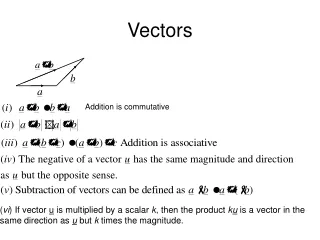
Adding Vectors • Can’t add apples and oranges • You can only add vectors that represent the same quantity and are drawn with the same scale (displacements, forces) • Resultant – sum of all vectors
Steps for Adding Vectors • Set up coordinate system • Place vector A • Place the tail of vector B at the tip of vector A (tip to tail) • Repeat step 3 if more than one vector • Draw a vector from the tail of the first vector to the tip of the last vector. Label this as you resultant • Use a ruler to measure the length of the resultant • Use a protractor to measure the angle between the resultant and the horizontal axis
Subtracting Vectors • Subtracting Vectors graphically • Δd = d2 – d1 • Δv = v2 – v1 • A-B same as A + (-B) • Negative vectors has the same magnitude and opposite direction
Steps for Subtracting Vectors • Set up coordinate system • Place vector A • Place the tail of negative vector B at the tip of vector A (tip to tail) • Draw a vector from the tail of the first vector to the tip of the last vector. Label this as you resultant • Use a ruler to measure the length of the resultant (magnitude) • Use a protractor to measure the angle between the resultant and the horizontal axis
Multiplying and Dividing Vectors • What happens to a vector when it is multiplied or divided by a scalar value? • V = Δd / t • When displacement (vector) is divided by time (scalar) the resulting vector has a new magnitude and unit but the direction remain the same.
Relative Velocity • Analyze quantitatively, the motion of an object is relative to different reference points • Eg: stopped at a red light, some times it feels like you’re moving backwards…are you? • Vector addition is a critical tool in calculating relative velocities
Pilot – ground and air as frames of reference • You must account for both the motion of the plane relative to the air and the air relative to the ground • Apply velocity vectors for each • Plane to air velocity + air to ground velocity plane velocity to ground