Exploring Perceptrons and Optimization Theories in Neural Networks
680 likes | 817 Vues
This chapter delves into Rosenblatt's perceptron model, focusing on the proofs of key theorems and methodologies in neural network optimization. It discusses the stochastic approximation method and sigmoid approximations of indicator functions, as well as potential functions and radial basis functions (RBFs). Key optimization theories, including Fermat's theorem, Lagrange multipliers, and the Kuhn-Tucker conditions, are examined in both deterministic and stochastic settings. The text emphasizes the learning process and the application of these theories in estimating coefficients and recognizing patterns.


Exploring Perceptrons and Optimization Theories in Neural Networks
E N D
Presentation Transcript
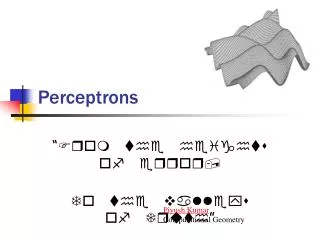
Rosenblatt’s perceptron • Proofs of the theorem • Method of stochastic approximation and sigmoid approximation of indicator functions • Method of potential functions and Radial basis functions • Three theorem of optimization theory • Neural Networks
Method of stochastic approximation and sigmoid approximation of indicator functions
Basic Frame for learning process • Use the sigmoid approximation at the stage of estimating the coefficients • Use the indicator functions at the stage of recognition.
Potential function • On-line • Only one element of the training data • RBFs (mid-1980s) • Off-line
Method of potential functions in asymptotic learning theory • Separable condition • Deterministic setting of the PR • Non-separable condition • Stochastic setting of the PR problem
Three Theorems of optimization theory • Fermat’s theorem (1629) • Entire space, without constraints • Lagrange multipliers rule (1788) • Conditional optimization problem • Kuhn-Tucker theorem (1951) • Convex optimizaiton
To find the stationary points of functions • It is necessary to solve a system of n equations with n unknown values.