Progress with intensified TB Case Finding in Nigeria
210 likes | 359 Vues
This presentation by Dr. E.B.A. Coker, Coordinator of the National HIV/AIDS Programme, outlines Nigeria's current challenges with tuberculosis (TB) amid a high HIV prevalence. It discusses the country's demographic structure, TB burden, and progress in intensifying TB case finding. Strategies include co-location of TB and HIV services, early symptom identification, and patient linkages to isoniazid preventive therapy (IPT). The conclusion emphasizes the importance of collaborative efforts to reduce TB incidence and improve health outcomes for people living with HIV.


Progress with intensified TB Case Finding in Nigeria
E N D
Presentation Transcript
Progress with intensified TB Case Finding in Nigeria Dr. E.B.A. Coker MD, MPH Coordinator National HIV/AIDS Programme
Presentation outline. • Country information. • HIV/AIDS profile. • TB burden. • Progress with intensifying TB case findings • Challenges. • Conclusion.
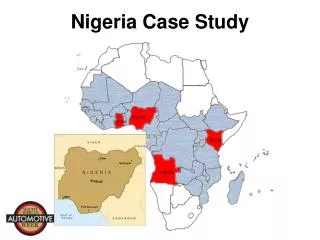
Country Information • Situated in West Africa. • Pop – 140M. (2006 census) • Federation of 36 states and FCT. • 774 LGAs. • 6 Geo Political zones • 927,000 sq m - Area • Presidential system of government • Health is on concurrent legislative list (NCH)
NIGERIA: HIV/AIDS PROFILE • HIV Prevalence (2005) 4.4% • Estimated Total PLWHAs 3m • PLWHAs Needing Treatment over 500,000 • Number of PLWHAs on ARV by June 2008 234,030 (15,104 - children) • Cumulative No of Deaths 1. 45 m.
Nigeria – TB burden • Nigeria currently ranked 5th among the 22 high TB burden countries • Estimated incidence for all cases is 311per 100,000 pop. (about 430,000 cases annually) • Estimated incidence for SM+ cases is 137 per 100,000 pop • Estimated prevalence of MDR-TB among new TB cases is 1.9% • TB burden is further compounded by high HIV prevalence • Prevalence of HIV among TB patients 27%
Strategies for strengthening Intensified TB case finding • Co-location of DOTS and HIV services. • Expansion of DOTS services to prisons and military barracks. • Screening for symptoms and signs of TB among clients at HIV service delivery centers • Early identification of signs and symptoms of TB. • Diagnosis and prompt treatment of TB.
Question in the Screening tools (Routine screening by HCWs of PLWHAs on a scale of 0-1) Health providers at HCT centres on Client intake form ask for: - Cough >3 weeks - Fever >3 weeks - Night sweats - Unexplained weight loss >= 3 Kg in last 4 weeks - Haemoptysis (coughing up blood or blood-tinged sputum) - Enlarged lymph nodes (>2 cm) - History of TB - Contact with a person with TB disease
Linking Intensifying case finding to IPT • National Policy for IPT for PLWHAs available. • IPT only for PLWHAs without active TB with no contraindication to INH. • Supply of INH for IPT among PLWHAs inadequate. • Linkage of PLWHAs (without active TB and contraindication to INH) to IPT still inadequate.
Linking Intensifying case finding to IPT (1st and 2nd quarter 2008)
Progress – “other component of the 3 Is” • National TB infection control Guidelines adapted. • SOP for TB infection control adapted. • Plan on to support trainings of State Programme managers and GHWs on TB-IC
Challenges • Weak systems for data collection, transmission and feed back. • Atypical presentation of TB in advancing HIV disease making diagnosis of TB difficult. • Inadequate linkage of Intensifying TB case findings to IPT.
Conclusion • Nigeria’s TB burden is compounded by high HIV prevalence • National strategic framework for strengthening Intensified TB case finding. • National Policy for IPT for PLWHAs (without active TB with no contraindication to INH) available. • Linking PLWHAs to IPT still inadequate (?supply of INH) • Progress is being made with implementation of TB-IC (as a component of 3 Is) • Access to HCT services by TB patients
Appreciation • ILEP(GLRA, DFB, NLR, TLMN) • USG (USAID, CDC, IHVN, MSH, AIDS relief, ICAP-Columbia, APIN) • CIDA • GFATM • WHO. • NEPHWAN.
Thank you! for listening TB HIV collaboration will lead us to beneficial health outcomes