Understanding the Transition to New Geometric Datums in U.S. Geospatial Data Management
This document explores the transition from the NAD83/NAVD88 datums to new geometric datums in U.S. geospatial data. It highlights the measures of success for adopting these new standards, including NOAA's commitment to consistency and user acceptance. The discussion points out potential risks, such as the resistance to change and the impact of legacy data systems. Key assumptions regarding international reference frames and data modernization tools are also examined. The goal is to facilitate a smooth transition while ensuring accurate and accessible geospatial information.

Understanding the Transition to New Geometric Datums in U.S. Geospatial Data Management
E N D
Presentation Transcript
New geometric datumprogress and plans joe.evjen@noaa.gov
2011 US Topo Map Slide by John Kosovich, USGS
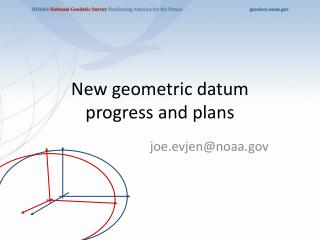
Simplified Concept of NAD 83 vs. ITRF2008 h08 h83 Earth’s Surface ITRF2008 Origin 2.2 meters NAD 83 Origin
Measures of Success • FGDC votes to adopt the new datum for U.S. geospatial data. • All NOAA geospatial products are consistent with the new datum. • NOAA geospatial products are understood and accepted by users. • Tools exist which facilitate modernization of legacy data. • New datums replace NAD83/NAVD88 in state and local regulations, documentation Risks • “Existing datums are good enough”, reduces enthusiasm for adopting the new. • Access to global (ITRF) & local (RTN, LDP) frames reduces the utility of a NAREF frame. • Das Unheimliche; frustration and cognitive dissonance increase with accuracy. Assumptions • IERS will continue to provide an ITRF common to all GNSS & other navigation systems. • GIS vendors will provide user-friendly solutions to modernize legacy data.
Source: Zurich-American Insurance Group A man with one watch will always know the time, A man with two watches will always be in doubt. • accessible • accurate • constant • seamless • simple
metadata to the rescue • your positional metadata should include: • datum • epoch • source • these will facilitate transforming from current to new datum • maintaining your original survey data will provide more accurate results
eppur si muove <and yet it moves> • A fixed reference frame will drift from international frame, at different rates for “unstable” parts of US
U.S. CORS Velocity Field – ITRF2008 (IGS08 epoch 2005.0) • accessible • accurate • constant • seamless • simple
U.S. CORS Velocity Field - NAD83(2011) epoch 2010.0 • accessible • accurate • constant • seamless • simple