Limitations on Board's Remedies in Ex-Cell-O: Understanding Employee Rights and Bargaining
40 likes | 149 Vues
The Ex-Cell-O case illustrates the complexities of the Board's remedial authority, emphasizing that it cannot punish respondents or impose irreparable harm. The dissent highlights employee deprivation of bargaining rights, contrasting the majority view of due process. The implications are significant, particularly regarding reimbursement of litigation expenses and the differing perceptions of due process. As the Board refrains from imposing prospective TCEs as seen in H.K. Porter, it raises essential questions about the rights of employees and the responsibilities of employers in unionized environments.


Limitations on Board's Remedies in Ex-Cell-O: Understanding Employee Rights and Bargaining
E N D
Presentation Transcript
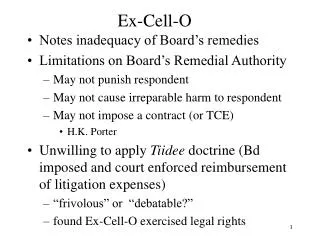
Ex-Cell-O • Notes inadequacy of Board’s remedies • Limitations on Board’s Remedial Authority • May not punish respondent • May not cause irreparable harm to respondent • May not impose a contract (or TCE) • H.K. Porter • Unwilling to apply Tiidee doctrine (Bd imposed and court enforced reimbursement of litigation expenses) • “frivolous” or “debatable?” • found Ex-Cell-O exercised legal rights
Ex-Cell-O Dissent • Employees deprived of right to bargain • TX not imposing a prospective TCE, as occurred in H.K. Porter • Can determine what ees would have received from objective evidence • other unionized facilities of firm • other unionized companies in industry
Differing Perceptions • Majority: Employer exercising rights to have a RD and Bd decision reviewed - due process • Dissent: Employer delaying its bargaining obligation • POINT: One person’s “delay” is another person’s “due process.”