Bubble acoustics
This research delves into the role of sound and bubbles in underwater environments. Highlights include the unique sonar capabilities of dolphins and the development of a pioneering sonar device capable of operating in bubbly water. The study also addresses gas transfer rates from ocean to atmosphere, focusing on the impact of bubbles under breaking waves. Additionally, it explores the use of bubble nets by humpback whales for prey capture and the significance of methane bubbles in underwater sediments for climate and engineering. For inquiries, contact T. G. Leighton at Southampton University.

Bubble acoustics
E N D
Presentation Transcript
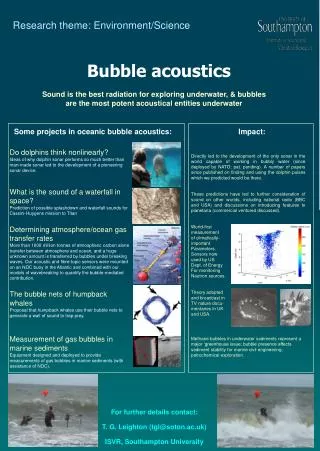
Research theme: Environment/Science Sound is the best radiation for exploring underwater, & bubbles are the most potent acoustical entities underwater Bubble acoustics Some projects in oceanic bubble acoustics: Impact: Do dolphins think nonlinearly? Ideas of why dolphin sonar performs so much better than man-made sonar led to the development of a pioneering sonar device. What is the sound of a waterfall in space? Prediction of possible splashdown and waterfall sounds for Cassini-Huygens mission to Titan Determining atmosphere/ocean gas transfer rates More than 1000 million tonnes of atmospheric carbon alone transfer between atmosphere and ocean, and a huge unknown amount is transferred by bubbles under breaking waves. Our acoustic and fibre-topic sensors were mounted on an NOC buoy in the Atlantic and combined with our models of wavebreaking to quantify the bubble-mediated contribution. The bubble nets of humpback whales Proposal that humpback whales use their bubble nets to generate a wall of sound to trap prey. Measurement of gas bubbles in marine sediments Equipment designed and deployed to provide measurements of gas bubbles in marine sediments (with assistance of NOC). Directly led to the development of the only sonar in the world capable of working in bubbly water (since deployed by NATO; pat. pending). A number of papers since published on finding and using the dolphin pulses which we predicted would be there. These predictions have led to further consideration of sound on other worlds, including national radio (BBC and USA) and discussions on introducing features to planetaria (commercial ventured discussed). World-first measurement of climatically- important Parameters. Sensors now used by US Dept. of Energy For monitoring Neutron sources. Theory adopted and broadcast in TV nature docu- mentaries in UK and USA. Methane bubbles in underwater sediments represent a major ‘greenhouse issue; bubble presence affects sediment stability for marine civil engineering; petrochemical exploration. For further details contact: T. G. Leighton (tgl@soton.ac.uk) ISVR, Southampton University